
هەواڵ
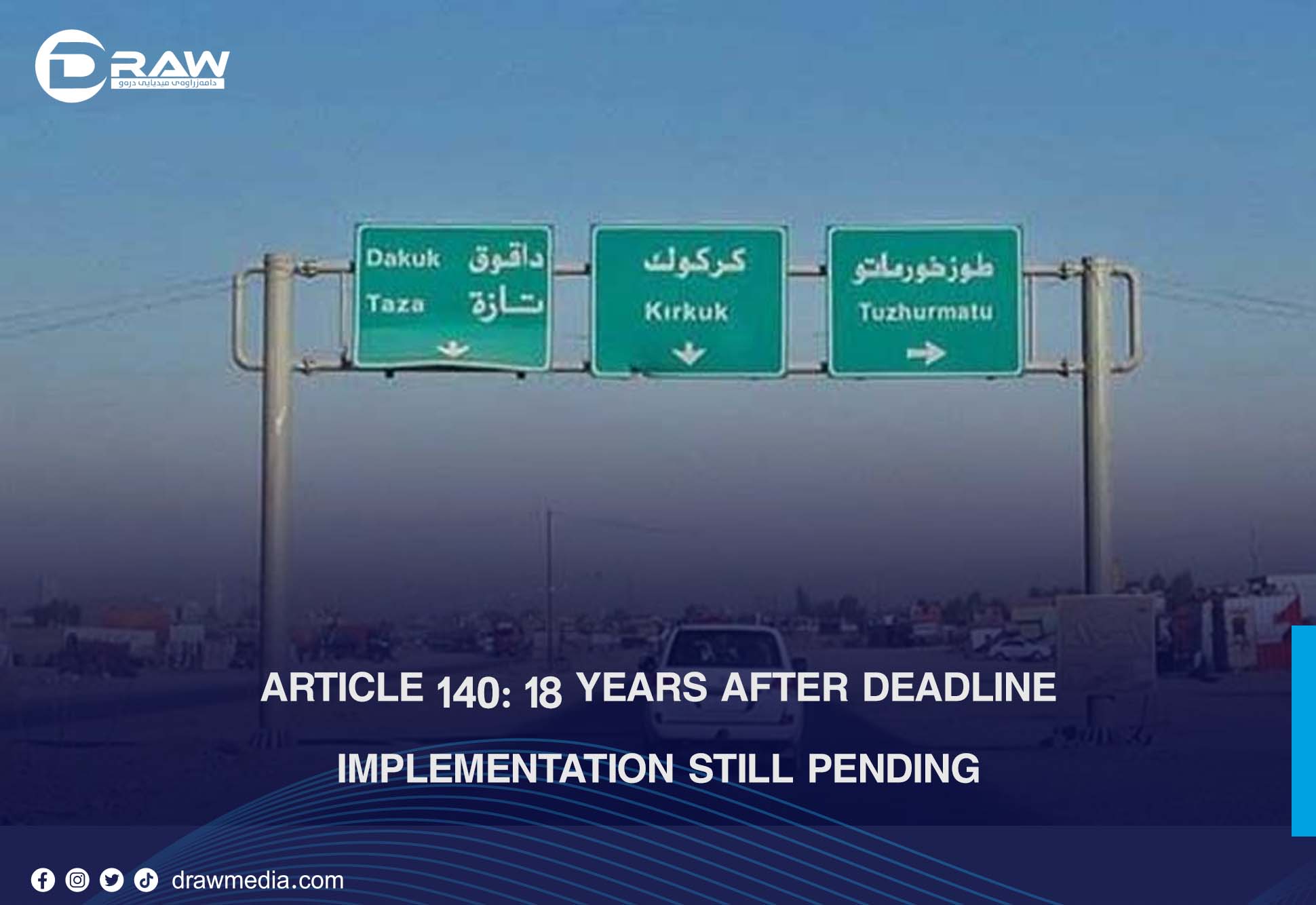
Article 140: 18 Years After Deadline, Implementation Still Pending
بڵاوکراوەتەوە لە : 22 شوبات 2026
قەبارەی دەقەکان
قەبارەی دەقەکان
هەواڵ
بڵاوکراوەتەوە لە : 22 شوبات 2026
قەبارەی دەقەکان
قەبارەی دەقەکان
Article 140, as an extension of Article 58 of the Transitional Administrative Law, remains unimplemented 18 years after the constitutional deadline expired.
From 2005 to 2025, several committees were formed to implement Article 140, with more than 2 trillion Iraqi dinars allocated, yet it has not been carried out.
Following the events of October 16, Arabization policies resumed under imposed administrations, major administrative changes were made, and dozens of senior Kurdish officials were removed.
Despite the Federal Supreme Court’s 2019 ruling affirming that Article 140 remains valid until fully implemented, and despite UN mediation efforts, political obstacles and the imposed security situation have delayed its execution.
Article 140, extending Article 58 of the Transitional Administrative Law, was designed to resolve the issue of disputed territories outside the Kurdistan Region’s administration. Its implementation was structured in three phases and was to be completed by the end of 2007, but it remains pending.
Between 2005 and 2025, multiple committees were formed and over 2 trillion dinars allocated, yet implementation has stalled.
After October 16, Arabization policies resumed under imposed administrations, significantly reducing Kurdish representation in senior posts.
In 2019, the Federal Supreme Court reaffirmed the article’s validity until full implementation, but political and security barriers persist.
First: The executive authority shall take the necessary steps to complete the implementation of Article 58 of the Transitional Administrative Law in all its provisions.
Second: The responsibility placed upon the Transitional Government shall transfer to the elected executive authority under this Constitution, to fully implement normalization, census, and ultimately a referendum in Kirkuk and other disputed areas to determine the will of their citizens, no later than December 31, 2007.
Article 140 outlines a three-stage process:
Normalization – Reversing Arabization policies, returning displaced persons, compensating victims, and repealing ethnic cleansing decisions.
Census – Conducting a transparent population census reflecting real demographics.
Referendum – Allowing residents to decide whether to remain under federal administration or join the Kurdistan Region.
These phases were meant to be completed before the end of 2007.
Implementation began under Article 58 of the Transitional Administrative Law. Committees were formed during the governments of Ayad Allawi (2005) and Ibrahim al-Jaafari (2006), but took no substantive steps.
Under Prime Minister Nouri al-Maliki’s first government, Executive Order No. 46 established a committee that issued key decisions, including:
Reinstating employees dismissed for political or ethnic reasons (Kurds, Turkmen, Assyrians).
Returning displaced families and compensating them.
Returning relocated Arab families to their original areas with compensation.
Cancelling agricultural contracts linked to demographic change policies.
Addressing land disputes and compensating affected residents.
Subsequent governments formed additional committees, including the High Committee headed by Hadi al-Amiri under Prime Minister Mohammed Shia’ al-Sudani, but without tangible results.
Achievements were minimal. Key obstacles included:
Failure to appoint committee leadership on time.
Short government tenures.
Lack of genuine political will within Iraq’s federal authorities.
Efforts to annul Ba’ath-era decisions targeting Kurdish lands led to thousands of agricultural contracts being revoked. However, the Ministry of Justice and certain Kirkuk judges failed to implement cabinet decisions.
Although laws were passed to annul Ba’ath Revolutionary Command Council decrees and restore property, practical steps remain absent.
The Property Claims Commission (Law No. 13 of 2010) has been largely ineffective due to political obstacles.
Executive Order No. 46 (2006) allocated $200 million for normalization and compensation. Between 2006 and 2025, special budget items were designated for Article 140, yet implementation has remained incomplete due to lack of transparency and oversight mechanisms.
Erbil Agreement (2010):
Signed between Masoud Barzani and Nouri al-Maliki, it reaffirmed commitment to Article 140 and constitutional provisions.
UN Mediation (UNAMI):
The UN Assistance Mission for Iraq proposed solutions for disputed territories, including census and administrative arrangements, but political disagreements prevented implementation.
Federal Supreme Court Rulings:
Decisions in 2017 and 2019 reaffirmed Article 140’s continued validity, while placing disputed areas under federal authority until resolution.
Iraqi forces and Popular Mobilization Forces moved into disputed territories, leading to displacement, alleged violations, and renewed Arabization measures.
Administrative changes reduced Kurdish representation in Kirkuk, Tuz Khurmatu, Khanaqin, Sinjar, and other areas.
Agricultural lands were reassigned to Arab settlers, and oil fields came under federal control.
On October 16, 2017, armed attacks targeted Kurdish neighborhoods and institutions, resulting in displacement, property destruction, and looting.
After 2017:
Kurdish administrative positions were replaced.
Arab settlers received documentation and residency support.
Agricultural lands were reassigned.
International organizations raised concerns over violations and called for neutral protection forces.