
هەواڵ
Attacks on Energy Infrastructure in the Kurdistan Region (2018–2025)
بڵاوکراوەتەوە لە : 9 کانوونی یەکەم 2025
قەبارەی دەقەکان
قەبارەی دەقەکان
هەواڵ
بڵاوکراوەتەوە لە : 9 کانوونی یەکەم 2025
قەبارەی دەقەکان
قەبارەی دەقەکان
Draw Media
KRG, Department of Media and Information
Introduction
The energy sector in the Kurdistan Region - an essential component of both Iraq’s national energy framework and the wider regional energy market - has been subjected to a sustained pattern of targeted attacks since 2018. What initially appeared as sporadic and low-impact incidents have evolved into increasingly sophisticated strikes employing ballistic missiles and unmanned aerial vehicles (UAVs).
This report documents the scope and consequences of these attacks, including material damages, operational disruption, and human casualties. Identifies outlines the implications for energy security and investment stability in the region.
All findings are presented on the basis of verified data and factual reporting, without political interpretation.
1. Timeline and Evolution of Targeting:
The campaign targeting energy-related assets in the Kurdistan Region can be divided into four distinct phases, each characterised by changes in method, precision, and objective.
Phase I (2018–2021): Low-Accuracy Harassment Attacks
During this period, oil fields and refineries were sporadically targeted with unguided Katyusha rockets. These attacks were largely imprecise, resulting in minimal damage and limited operational disruption. Their primary effect was symbolic rather than structural.
Phase II (2022): Shift to Precision and Strategic Targeting
In 2022, the nature of the attacks escalated significantly with the use of long-range, high-precision weaponry.
• 13 March 2022: Twelve ballistic missiles struck a private residence in Erbil belonging to an energy sector investor (CEO of KAR Group), completely destroying the property. This marked the first documented instance of direct targeting of private capital through a precision missile attack.
• April–May 2022: Grad rockets and UAVs launched from the Nineveh Plains targeted the Kalak refinery, damaging fuel storage facilities and confirming a shift toward degrading energy processing infrastructure.
Phase III (2023–2024): Direct Strikes on Production and Personnel
This phase was characterised by direct attacks intended to cause disruption to operations and loss of life:
• 26 April 2024: A UAV strike on the Khor Mor gas field killed four technical staff and temporarily halted gas production, demonstrating the capability to strike active operational facilities.
• 15 December 2024: A ballistic strike on the home of businessman Peshraw Dizayee, CEO of Falcon Group, resulted in the deaths of the investor, members of his family—including his infant daughter—and civilian guests.
Phase IV (2025): Systemically Disruption of Energy Supply
By 2025, attacks appeared designed to inflict widespread economic damage across interconnected energy systems:
• July 2025: Coordinated UAV attacks targeted five oil fields - Khurmala, Sarsang, Peshkhabur, Tawke, and Sheikhan - reducing oil production by an estimated 220,000 barrels per day.
• 26 November 2025: A precision strike hit an LPG storage facility at the Khor Mor gas field.
2. Data Background: Electricity System Impact: Khor Mor Field Attack:
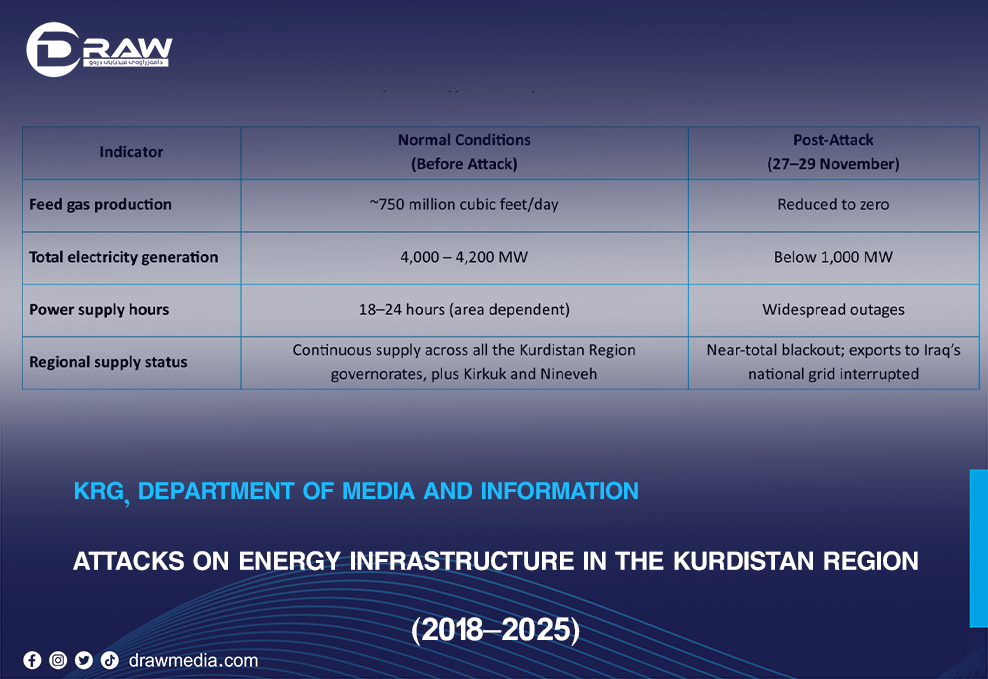
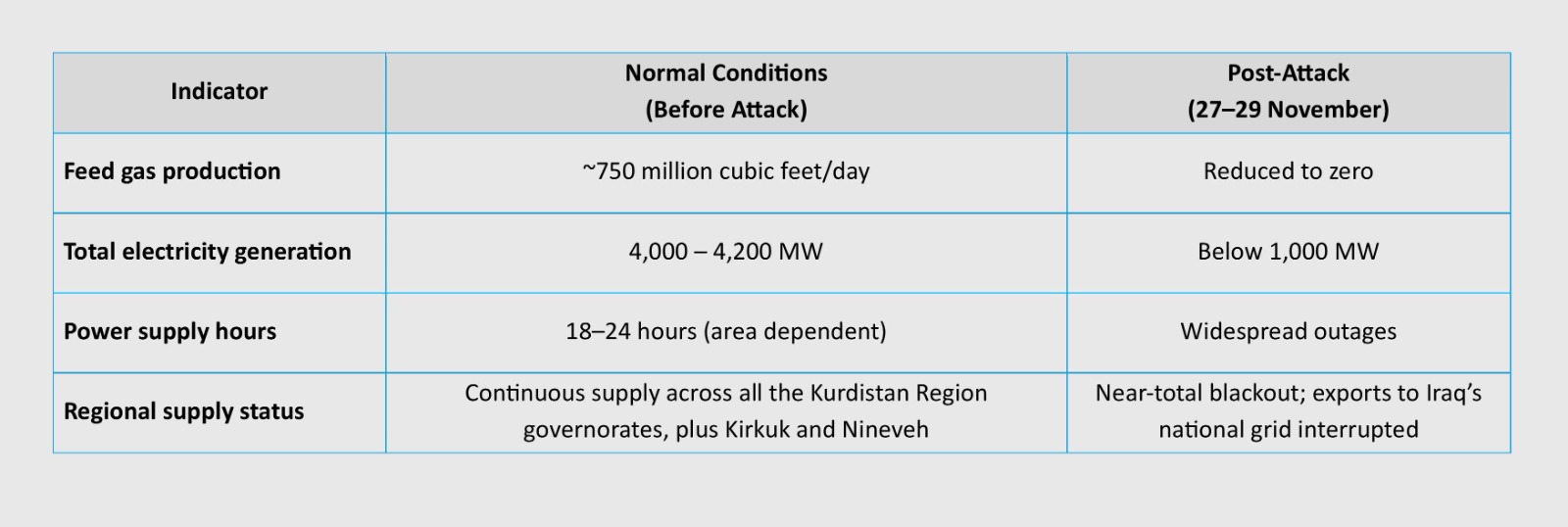
The table below provides a comparative overview of electricity production and supply conditions before and after the November 2025 attack on the Khor Mor gas field, illustrating the immediate impact of the disruption on power generation and regional electricity availability.
3. Summary of Major Incidents and Impacts (2022–2025):
The following table summarises the most significant attacks targeting energy-related assets between 2022 and 2025, including the date, location, weapon type, point of launch, and the resulting operational, economic, and human impacts.
4. Economic and Energy Security Implications:
The cumulative impact of these attacks has:
• Disrupted oil and gas production and processing capacity
• Reduced electricity generation and stability across the Kurdistan Region
• Affected household and industrial power supply
• Increased operational risks and insurance costs for investors
Short-term disruptions have translated into broader economic consequences, particularly during peak seasonal demand, with ripple effects extending beyond the Kurdistan Region into Iraq’s national grid.
Conclusion:
The period from 2018 to 2025 reflects a clear evolution in the targeting of energy infrastructure in the Kurdistan Region - from low-impact harassment to precision strikes aimed at systemic disruption. The data presented demonstrate that energy installations, personnel, and associated civilian environments have increasingly become focal points of attack.
This report aims to contribute to informed understanding among policymakers, energy stakeholders, researchers, and international partners by presenting a factual record of events and their consequences. Continued monitoring, documentation, and protection of critical energy infrastructure remain essential for safeguarding energy security, economic stability, and civilian well-being.
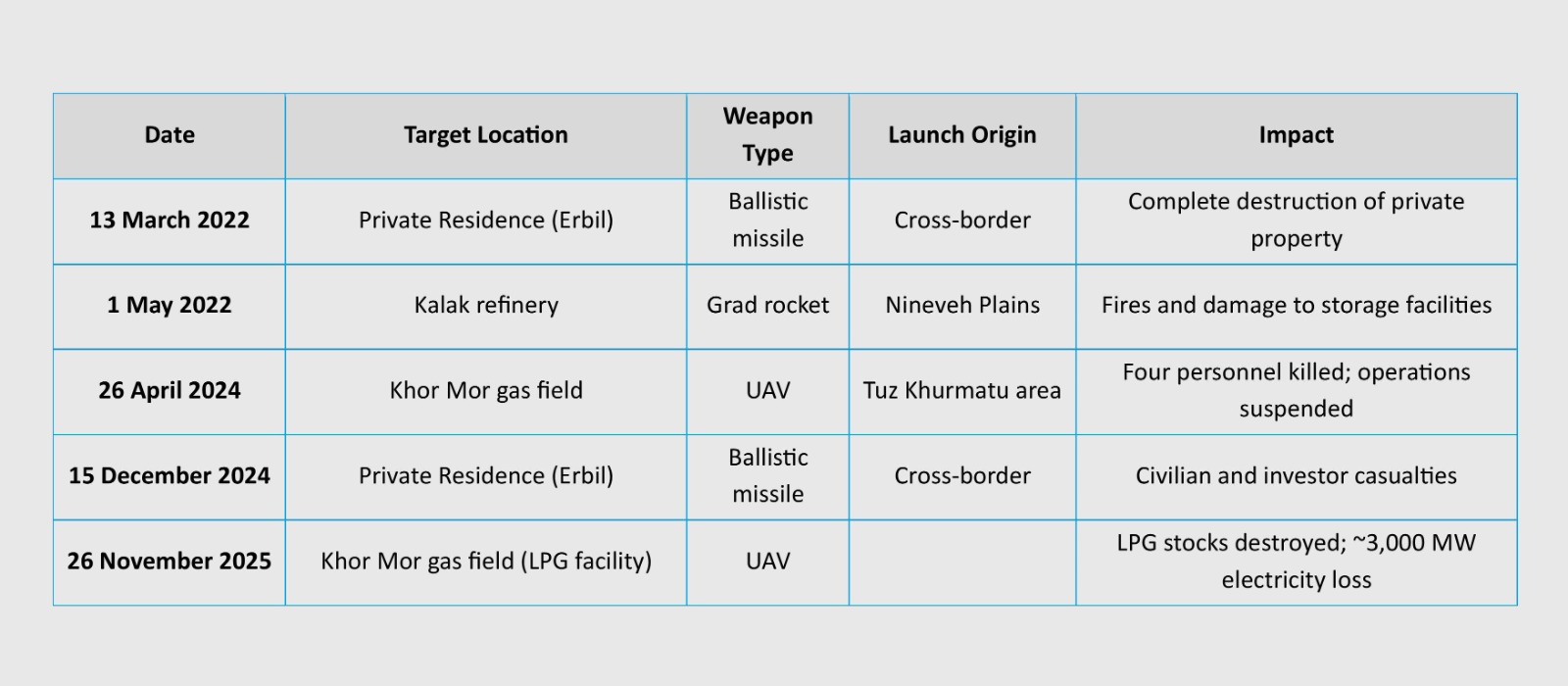
Source; KRG, Department of Media and Information