

Attacks targeting the Ashrafieh and Sheikh Maqsoud neighborhoods
2026-01-07 19:41:23
Draw Media
Foreign Relations Department – Autonomous Administration of North and East Syria 07 January 2026
Locations:
The Sheikh Maqsoud neighborhood enjoys a unique strategic location in the northern part of the city of Aleppo, as it lies atop an elevated hill that grants it wide oversight of the city and both banks of the Quweiq River. The neighborhood is bordered to the east by the railway line that connects to Turkish territory, and to the south by the Christian cemeteries and the French military cemetery.
As for the Ashrafieh neighborhood, it is located directly southwest of Sheikh Maqsoud, forming an urban extension of it. Together, the two neighborhoods overlook the Lairamoun industrial area and the Castello Road to the north and west, in addition to the Youth Housing neighborhood, which gives them significant military importance due to the geographical elevation and control over vital axes within the city.
The elevated location of Sheikh Maqsoud is considered a decisive factor in the dynamics of the conflict, as it provides a tactical advantage for surveillance and control over the surrounding areas. This advantage has made the two neighborhoods frequent targets of attacks, and at the same time a stronghold for the residents’ self-defense, with the Ashrafieh neighborhood serving as a complementary area that reinforces this strategic importance.
Armed Factions Attacking the Sheikh Maqsoud and Ashrafieh Neighborhoods:
The military factions affiliated with Turkey and operating under the authority of the Ministry of Defense of the Syrian Interim Government in Damascus are carrying out attacks on the two neighborhoods using all types of heavy weapons (heavy machine guns, rocket launchers, mortars, artillery, tanks, and drones). Meanwhile, the two neighborhoods are devoid of any military presence, with only Internal Security Forces present to ensure security and stability within the neighborhoods.
Armed Factions Attacking the Two Neighborhoods:
• The 60th Division, formed of hardline elements formerly affiliated with Hay’at Tahrir al-Sham (HTS). It is led by Awad al-Jassem, known as “Abu Qutayba al-Manbiji,” one of the prominent commanders within HTS. The deputy commander of the division is Mudar Najjar, a senior figure among the factions active in northern Aleppo, most recently the Sham Front, and originally from the city of Mare’.
• The 76th Division, formed from the Turkey-backed Hamzat faction, led by Saif al-Din Boulad, known as “Abu Bakr,” who is listed under U.S. sanctions. By the end of 2025, the United Kingdom also imposed sanctions on this faction and its leader.
• The 72nd Division, which includes fighters from several Turkey-backed factions, and is led by a former commander in Hay’at Tahrir al-Sham known as “Khattab al-Albani.”
• The 80th Division, led by Khaled al-Omar, a defected officer who commanded several factions during the Syrian crisis, the most recent of which was within the Syrian National Army.
Violations:
The Sheikh Maqsoud and Ashrafieh neighborhoods are subjected to systematic violations by armed factions affiliated with the Transitional Government, including repeated shelling, a suffocating siege, and attacks on civilians. These violations exacerbate the humanitarian situation and create an environment of fear and instability.
The Sheikh Maqsoud and Ashrafieh neighborhoods have been subjected to repeated bombardment with mortars, heavy machine guns, drones, artillery, and tanks since 22 December 2025. These attacks have been described as “war crimes” by human rights organizations.
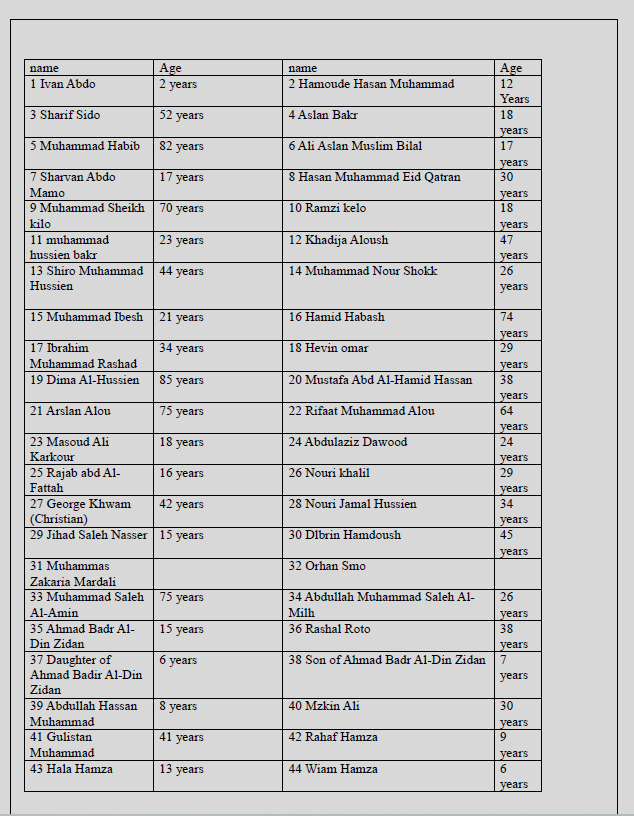
• On 22 December 2025, a joint checkpoint of the Internal Security Forces (Asayish) and the General Security Forces at Sheihan Roundabout in the city of Aleppo was subjected to an armed attack carried out by factions affiliated with the Ministry of Defense of the Interim Government. This was followed by heavy-weapons attacks on both neighborhoods, resulting in the deaths of five people and injuries to 23 civilians with varying degrees of severity.
The two neighborhoods also experienced a complete cutoff of water, electricity, and internet services, in addition to a shortage of diesel fuel. Armed factions continue to prevent the entry of food supplies, while simultaneously restricting the entry and exit of residents to and from the two neighborhoods.
• On 28 December 2025, armed factions affiliated with the Ministry of Defense of the Interim Government abducted two university students from the Sheikh Maqsoud and Ashrafieh neighborhoods while they were returning home after their university classes.
• On the evening of 6 January 2026, factions affiliated with the Interim Government launched a large-scale attack on the Sheikh Maqsoud and Ashrafieh neighborhoods in Aleppo. These neighborhoods are home to more than 500,000
residents (approximately 55,000 Kurdish families, in addition to Kurdish displaced persons who were forced to leave the Afrin area, which is controlled by Turkey-backed factions).
The attacks began with targeting some civilians by the Ministry of Defense-affiliated forces using suicide drones, initially injuring three civilians severely. This was followed by a campaign of indiscriminate shelling aimed at neighborhoods inhabited by unarmed civilians.
The 60th Division deployed a convoy of tanks and armored vehicles in an attempt to forcibly enter the neighborhoods. This was accompanied by the forcible removal of civilians from surrounding areas of the Kurdish neighborhoods to position snipers and deploy tanks within those neighborhoods—a dangerous escalation that threatens civilian safety and turns the residential area into a military zone.
Alongside the arrival of military reinforcements, a heavy bombardment campaign was launched in which the Interim Government’s Ministry of Defense forces used all types of heavy weapons (tanks, heavy artillery, Grad and Katyusha rocket launchers, mortars, and Dushka machine guns of all kinds), in addition to suicide drones and high-destruction weapons. This resulted in the killing of four civilians—including two women and a child—and injuries to 35 others, including children. Dozens of homes and civilian buildings were also severely damaged due to the impact of shells and rockets.
Subsequently, after intensive efforts to halt the clashes and return to dialogue, the Kurdish neighborhoods experienced a cautious calm, accompanied by a preliminary agreement for a ceasefire. However, the factions resumed violent attacks on the three neighborhoods shortly thereafter.
Amid the ongoing attacks and the imposed siege, the two neighborhoods continue to face a serious humanitarian disaster. Ambulance teams and medical staff are unable to move to evacuate the injured. There is also a shortage of doctors across all specialties, and armed factions are preventing doctors from outside the neighborhoods from entering.

.jpg)

.png)


.jpg)

.jpg)
.jpg)