Elections and Government Formation in the Kurdistan Region
- The absence of a permanent constitution in the Kurdistan Region has weakened the pressure to form a government promptly. This legal flexibility has allowed political parties to prolong negotiations indefinitely.
- The government formation process in the Kurdistan Region has consistently depended on an agreement between the two main political forces, the Kurdistan Democratic Party (KDP) and the Patriotic Union of Kurdistan (PUK). Whenever these two parties disagree over positions, revenues, or administrative zones, the process comes to a complete standstill.
- Prolonged waiting means that previous governments remain in power with reduced authority. This undermines the legitimacy of the ballot box because citizens vote for change.
- When voters see that, even after hundreds of days — 725 days in the Kurdistan Region, for example — political parties still cannot reach an agreement at the negotiating table, their trust in the democratic process itself erodes. This is a key factor contributing to declining voter turnout in successive elections.
- The data indicate that the model of “quota-sharing democracy” has faced a deadlock at the regional level in recent years. However, the Kurdistan Region’s situation during its sixth parliamentary term has entered an even more critical phase. The prolonged period of nearly two years without a clear prospect of forming a government indicates that the Region’s internal mechanisms for resolving crises require fundamental legal and structural reform.
First: Elections and Government Formation in the Kurdistan Region
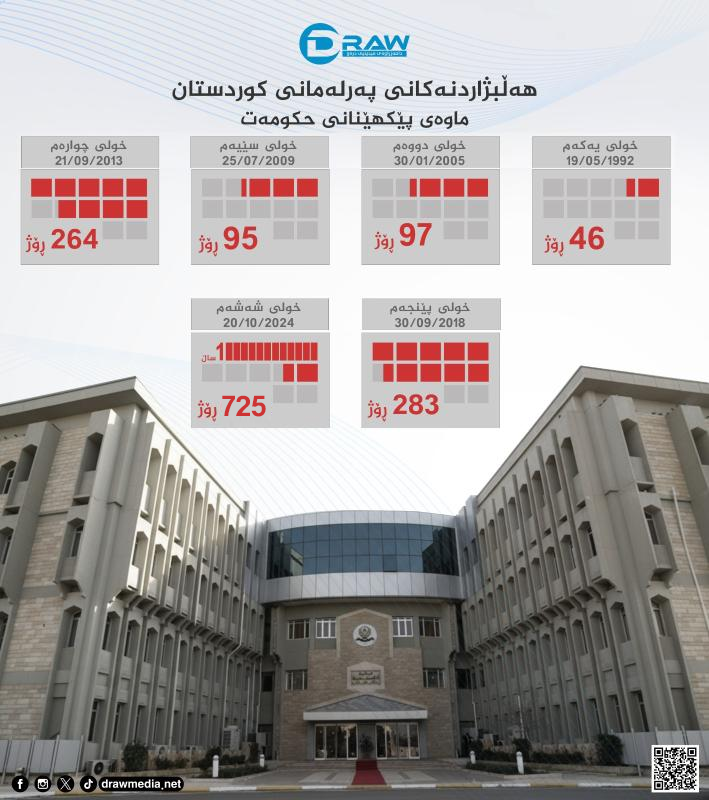
The political process in the Kurdistan Region, particularly since 1992 and the formation of the first cabinet, has developed its own distinct dynamics. In most parliamentary terms, the period between holding elections and reaching a final agreement to form a cabinet has involved lengthy negotiations and considerable delays.
1. First Parliamentary Term (First Cabinet — Fuad Masum, 1992)
Dates: May 19, 1992 – July 4, 1992
The Kurdistan Region’s first parliamentary election was held following the uprising and the withdrawal of the Ba’ath regime’s institutions. The first regional government was subsequently formed under Fuad Masum.
Time between the election and government formation: 46 days (1 month and 15 days).
2. Second Parliamentary Term (Fifth Cabinet — Unification Government, Nechirvan Barzani, 2005–2006)
Dates: January 30, 2005 – May 7, 2006
Negotiations led to the formation of a unified cabinet that brought together the administrations of Erbil and Sulaymaniyah after several years of administrative division. Nechirvan Barzani was appointed to lead the government.
Time between the election and government formation: 462 days (1 year, 3 months, and 7 days).
3. Third Parliamentary Term (Sixth Cabinet — Barham Salih / Seventh Cabinet — Nechirvan Barzani, 2009)
Dates: July 25, 2009 – October 28, 2009
Following the third parliamentary election, negotiations centered on implementing a strategic agreement between the KDP and PUK to rotate the premiership, initially appointing Barham Salih and subsequently Nechirvan Barzani.
Time between the election and government formation: 95 days (3 months and 3 days).
4. Fourth Parliamentary Term (Eighth Cabinet — Nechirvan Barzani, 2013–2014)
Dates: September 21, 2013 – June 18, 2014
Disputes and intensive negotiations between political parties followed the emergence of the Change Movement (Gorran) as the second-largest political force. These developments prolonged the formation of a broad-based government under Nechirvan Barzani.
Time between the election and government formation: 270 days (exactly 9 months).
5. Fifth Parliamentary Term (Ninth Cabinet — Masrour Barzani, 2018–2019)
Dates: September 30, 2018 – July 10, 2019
The process of forming the ninth cabinet under Masrour Barzani was prolonged by intense internal political disputes over government positions and the circumstances following the events of October 16 and the situation in Kirkuk.
Time between the election and government formation: 283 days (9 months and 10 days).
6. Sixth Parliamentary Term (Tenth Cabinet — 2024–2026)
Dates: October 20, 2024 – present (October 15, 2026)
The Kurdistan Region is currently experiencing what the analysis describes as its longest period of political deadlock. Negotiations following the sixth parliamentary election remain ongoing, and the tenth cabinet has yet to be formed because of deep disagreements between the main political blocs.
Time since the election: 725 days (1 year, 11 months, and 25 days).
Key Observations
- Longest period of political deadlock: The current sixth parliamentary term (2024–2026) has reached 725 days, making it the longest government formation process in the Region’s history. It has exceeded even the 462-day period required to form the unified government.
- Shortest period: The first term in 1992, under Fuad Masum, took only 46 days. This was because it was the beginning of the political process and there was a degree of national consensus around the urgent need to establish institutions.
- Historical average: Excluding the exceptional first and sixth terms, the average time required to form a government in the Kurdistan Region has generally ranged from three to nine months. This indicates that the dynamics of political agreements between the two main parties have become increasingly complex and difficult over time.
Table
The original article includes a table image comparing the periods between elections and government formation.
Reading the Table in Historical Context
- The establishment and unification period (1992–2006): The process evolved from the shortest period, 46 days, driven by the urgent need to establish institutions, to the longest deadlock of that era, lasting 462 days. The main reason was the complex process of unifying the administrative systems of the Green Zone and the Yellow Zone.
- The period of multidimensional political competition (2009–2019): After 2009, the time required to form governments increased significantly, from 95 days to 270 and then 283 days. This reflected changes in the Region’s political landscape, the emergence of broad-based government arrangements, and the difficulty of reaching agreements on financial and administrative power-sharing.
- The current sixth parliamentary term (2024–2026): This period represents the highest level of political deadlock in the Region’s history, reaching 725 days. It demonstrates how internal disputes and national and regional factors have reached a level that has effectively stalled the implementation of electoral outcomes.
Second: The Kurdistan Region’s Political System in Terms of Elections and Government Formation
In light of the data presented above, these figures are more than just a count of days. They reflect the realities of political competition, power dynamics, legal provisions, and the nature of democracy. The following analysis examines several key dimensions.
1. Legal and Constitutional Analysis
Laws and constitutions are the fundamental frameworks that determine the timeframe for forming governments. However, their implementation differs in the Kurdistan Region.
The absence of a permanent constitution and reliance on Kurdistan Parliament Law No. 1 of 1992 have meant that there are no strict, time-bound requirements comparable to those in Baghdad. This legal flexibility has allowed political parties to prolong negotiations indefinitely, as demonstrated by the current sixth parliamentary term, which has reached 725 days without a decisive legal mechanism to resolve the impasse.
2. Political Analysis and Power Dynamics
The number of days provides a direct measure of the level of competition and rivalry between political parties.
In the Kurdistan Region, government formation has consistently depended on an agreement between the two main political forces, the KDP and the PUK. When they disagree over government positions, revenues, or administrative zones, the process comes to a standstill.
The current sixth term, cited in this section as lasting 590 days, and the second term, which lasted 462 days, illustrate the severity and duration of two-bloc political competition in the Kurdistan Region compared with the multipolar political competition in Baghdad. The analysis argues that there is no third force in the Region capable of maintaining the balance or acting as a mediator between the two dominant parties.
3. Democracy and Public Trust
From this perspective, prolonged government formation significantly undermines the foundations of democracy.
- The phenomenon of a caretaker government: Prolonged delays mean that previous governments remain in power with reduced authority. This weakens the legitimacy of electoral outcomes because citizens vote for change, yet the same political figures continue governing for a year or longer.
- Voter disengagement: When voters see that political parties remain unable to reach an agreement even after hundreds of days — 725 days in the Kurdistan Region — their trust in the democratic process itself declines. This is a key factor contributing to falling voter turnout in successive elections.
Conclusion
The data indicate that the model of “quota-sharing democracy” has reached a deadlock at the regional level. However, the Kurdistan Region’s situation during its sixth parliamentary term has entered an even more critical phase.
The prolonged delay of nearly two years, without a clear prospect of forming a government, suggests that the Region’s internal mechanisms for resolving political crises require fundamental structural and legal reform.