Iraq’s total oil refining capacity increased to 1.434 million barrels per day in 2025, representing 13% growth compared with 2024.
A significant gap of 643,000 barrels per day remains between the country’s installed refining capacity and the actual average operating rate of its refineries, which stands at 791,000 barrels per day.
Domestic demand for gasoline reached 195,000 barrels per day last year, compared with average domestic production of only 86,000 barrels per day.
Iraq’s seaborne gasoline imports fell by 42% during the first eight months of 2026, dropping to 21,000 barrels per day due to disruptions in the Strait of Hormuz.
The UAE alone supplied more than 80% of Iraq’s seaborne gasoline imports, while Iraq was also forced to resort to importing US gasoline through Syria’s Baniyas port.
Introduction
Iraq’s oil refining sector consists of 17 refineries that play a major role in meeting domestic fuel demand. Nevertheless, the country continues to import certain types of fuel to make up for shortages in the domestic market.
According to available data and statistics from the Energy Research Unit, headquartered in Washington, Iraq’s total refining capacity increased to 1.434 million barrels per day in 2025, compared with 1.266 million barrels per day in 2024, representing a growth rate of 13%.
However, the actual average operating rate of the country’s refineries last year stood at 791,000 barrels per day. This highlights a substantial gap between installed refining capacity and actual refining output, amounting to 643,000 barrels per day, while the country continues to rely on imports of certain petroleum products to meet domestic demand.
This situation became particularly evident in recent months when maritime oil and fuel supplies through the Strait of Hormuz were disrupted. As a result, Iraq experienced congestion and long queues at fuel stations. This forced the country to import larger quantities of gasoline directly from Jordan, Saudi Arabia and the United Arab Emirates (UAE), as well as from Europe and the United States through Syria.
Against this backdrop, Iraq has intensified efforts to rehabilitate and develop refineries that were damaged by instability and terrorist attacks. These efforts are part of a plan aimed at ending fuel imports and achieving self-sufficiency, with the ultimate goal of beginning petroleum product exports in the coming phase.
Iraq’s Oil Refining Sector in 2025
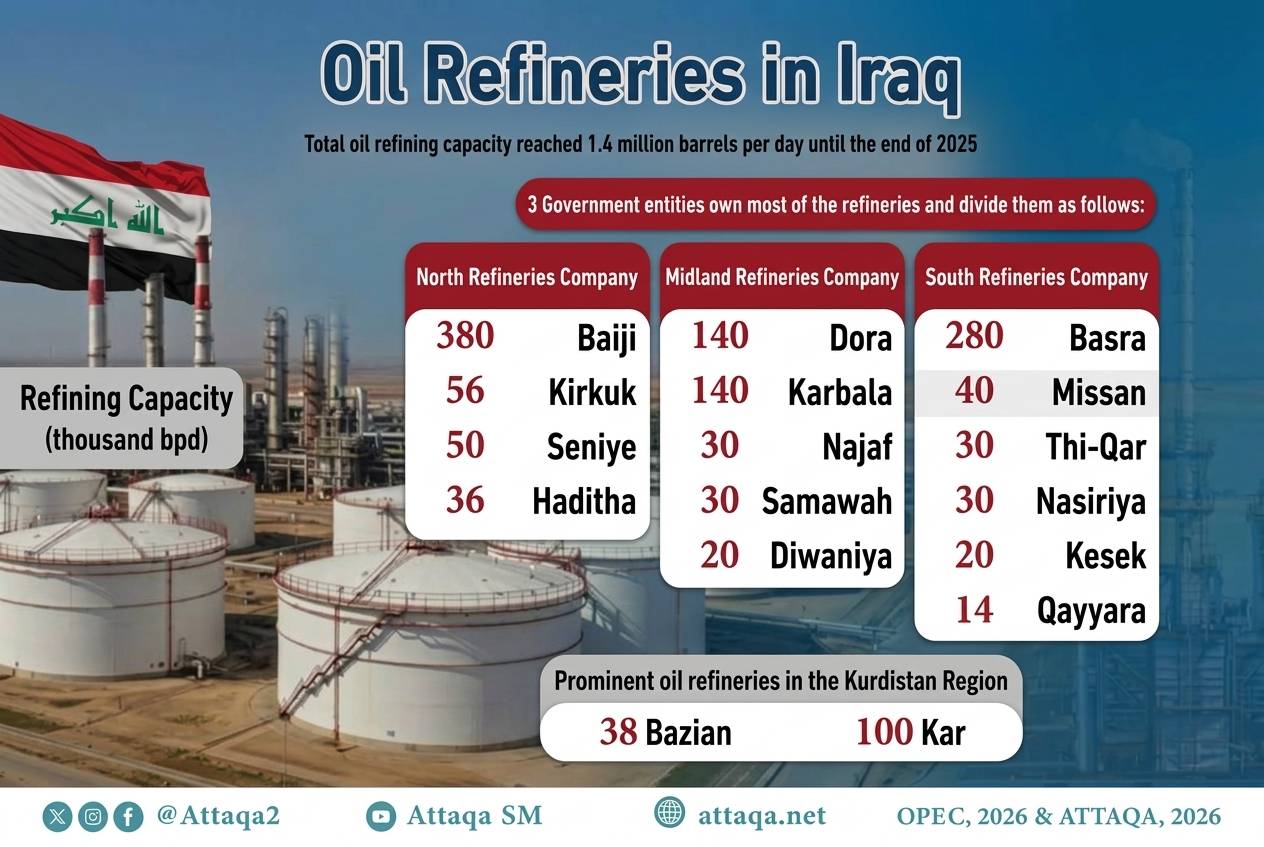
According to the annual reports of the Organization of the Petroleum Exporting Countries (OPEC), Iraq’s oil refining sector succeeded in increasing the capacity of four refineries last year. The refining capacities of the country’s facilities are as follows:
Refinery
Capacity (barrels per day)
Samoud (Al-Sumoud)
380,000
Basra
280,000
Karbala
140,000
Doura
140,000
KAR
100,000
Kirkuk
56,000
Siniya
50,000
Maysan
40,000
Bazian
38,000
Haditha
36,000
Najaf
30,000
Samawah
30,000
Nasiriyah
30,000
Diwaniyah
20,000
Thi Qar
30,000
Kasak
20,000
Qayyarah
14,000
Iraq’s oil refining sector witnessed expansion last year, most notably through the increase in the capacity of the Samoud refinery in the city of Baiji, which rose from 290,000 to 380,000 barrels per day, an increase of 90,000 barrels per day.
Notably, the Samoud refinery officially resumed operations in February 2024 following the completion of its rehabilitation works. This came after it sustained extensive damage in 2014 as a result of attacks by the terrorist organization ISIS.
Furthermore, according to data obtained by the Energy Research Unit, the capacity of the Basra refinery increased from 210,000 to 280,000 barrels per day, an increase of 70,000 barrels per day.
Meanwhile, the capacity of the Siniya refinery increased by 20,000 barrels per day, reaching a total of 50,000 barrels per day. The capacity of the Haditha refinery also rose from 16,000 to 36,000 barrels per day, an increase of 20,000 barrels per day.
On the other hand, two refineries experienced declines in their capacities. The first was the KAR refinery, whose capacity fell from 160,000 to 100,000 barrels per day. The second was the Bazian refinery in the Kurdistan Region, where refining capacity decreased from 40,000 to 38,000 barrels per day.
In general, ownership of most oil refineries in Iraq is distributed among three main state-owned companies:
North Refineries Company.
Midland Refineries Company.
South Refineries Company.
As illustrated in the following chart:
The Iraqi Petroleum Products Market
Iraq’s production of petroleum products increased to 990,000 barrels per day in 2025, continuing its upward trajectory over the past five years, with cumulative growth of 34% compared with 740,000 barrels per day in 2021.
Despite this increase, Iraq continues to face shortages in meeting domestic demand for certain petroleum products, particularly gasoline. Demand for gasoline reached 195,000 barrels per day last year, compared with average domestic production of only 86,000 barrels per day.
Due to this shortfall, Iraq continues to import petroleum products. However, imports declined for the third consecutive year in 2025, reaching 48,000 barrels per day, compared with 75,000 barrels per day in 2024.
Currently, the Iraqi market requires approximately five million litres of imported gasoline daily, equivalent to 31,000 barrels per day, to bridge the gap between domestic production and consumption, while efforts to increase output from the country's oil refineries continue.
According to data from the Energy Research Unit, Iraq’s seaborne gasoline imports reached 21,000 barrels per day between January and the end of August 2026, compared with 36,000 barrels per day during the same period in 2025.
This decline of 42% during the first eight months of 2026 was caused by disruptions to maritime supplies through the Strait of Hormuz as a result of the war involving Iran. This situation created a crisis in the domestic market. The following chart illustrates Iraq’s monthly gasoline import volumes.
These maritime shipments originated from only two countries: the UAE and India, with the UAE alone accounting for more than 80% of the supply.
As part of its efforts to find a rapid alternative to overcome the crisis caused by the closure of the Strait of Hormuz, Iraq resorted to importing a large shipment of US gasoline through Syria’s Baniyas port and transporting it overland by tanker trucks. The cost of this shipment is estimated to have been among the highest in the world.
As part of its efforts to find a rapid alternative to overcome the crisis caused by the closure of the Strait of Hormuz, Iraq resorted to importing a large shipment of US gasoline through Syria’s Baniyas port and transporting it overland by tanker trucks. The cost of this shipment is estimated to have been among the highest in the world.
Source: Report by Ahmed Ammar, published on October 3, 2026, by Al-Taqa (Energy).