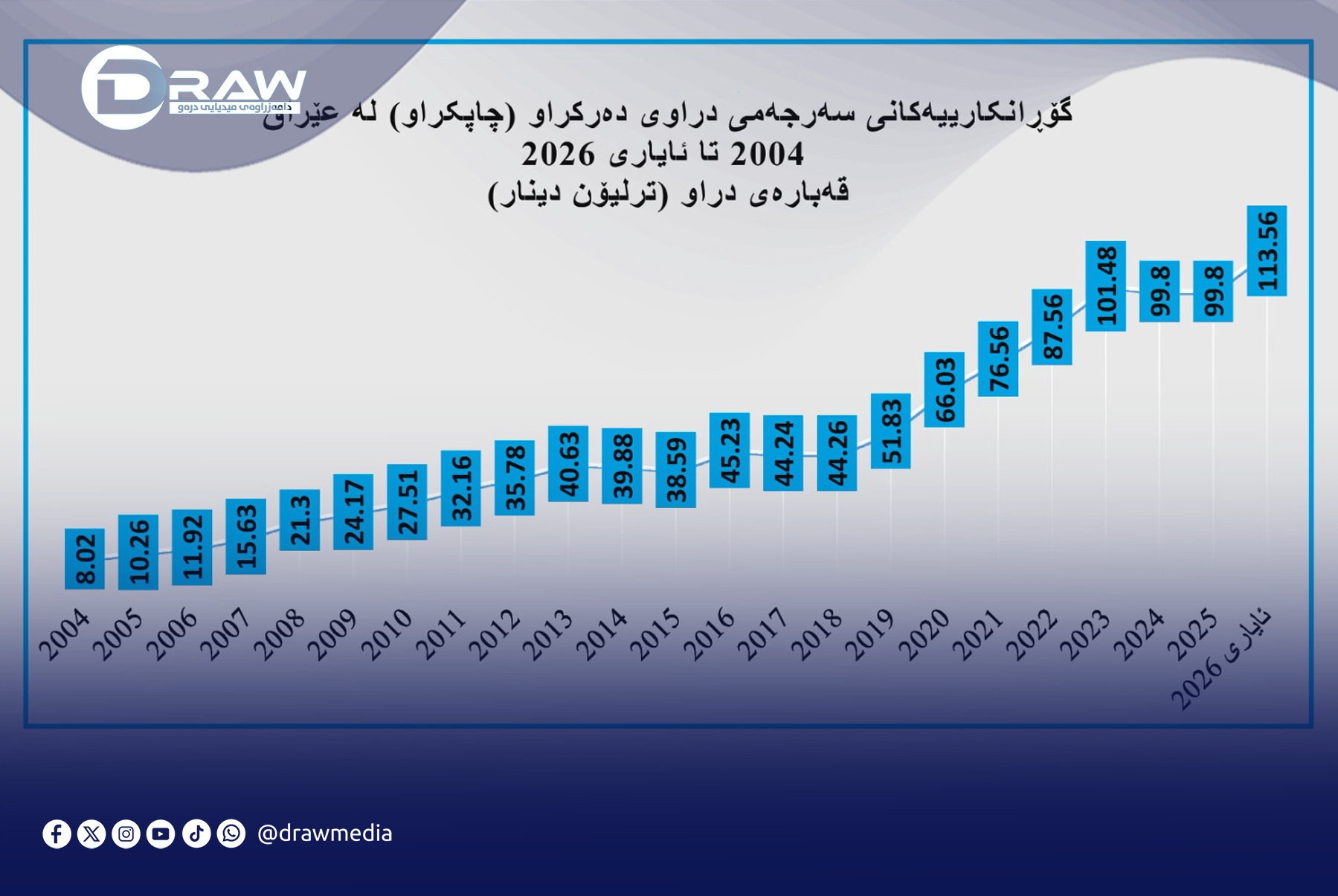
🔹 Iraq’s currency issuance has experienced a major surge, rising from approximately IQD 8.02 trillion in 2004 to a historic high of IQD 113.56 trillion in May 2026. This represents growth of 1,316%, or more than fourteen times. In the first five months of 2026 alone, issued currency increased by 11.98%, from IQD 101.43 trillion to IQD 113.56 trillion.
🔹 Currency held by commercial banks stood at its lowest level of IQD 857.6 billion in 2004, before reaching its highest level of IQD 9.04 trillion in October 2023. This represents an increase of 951% between its lowest and highest levels. However, in May 2026, the amount recorded a significant monthly decline of 19.22% compared with April, falling from IQD 8.35 trillion to IQD 6.75 trillion.
🔹 Currency outside the banking system, circulating in the market, stood at its lowest level of IQD 9.11 trillion in 2005, but climbed to a historic high of IQD 106.81 trillion in May 2026. This represents growth of 1,072%. Currency outside banks accounted for more than 94% of total issued currency in May 2026, clearly indicating that the overwhelming majority of Iraq’s cash liquidity remains outside the banking system and is used in cash transactions.
Introduction
The growth of issued currency, currency circulating in the market outside the banking system, and currency held by banks are among the most important monetary indicators for assessing the volume of cash liquidity and trends in cash transactions in Iraq’s economy between 2004 and May 2026.
These indicators are particularly important because they show the relationship between currency issuance on one hand, the amount of cash held by the banking system on the other, and the volume of currency circulating outside banks, which represents the largest share of cash circulating in the economy.
First: Overall Growth of Issued Currency
The volume of issued currency followed a clear upward trend during most of the period between 2004 and 2026. It rose from approximately IQD 8.02 trillion in 2004 to IQD 10.26 trillion in 2005, continuing to increase until reaching IQD 21.30 trillion in 2008. It then climbed to IQD 35.78 trillion in 2012 and IQD 40.63 trillion in 2013.
In 2014, issued currency recorded a slight decline of 1.84%, falling to approximately IQD 39.88 trillion. The decline continued in 2015 at a rate of 3.26%. However, 2016 saw strong growth of 17.23%, bringing issued currency to approximately IQD 45.23 trillion. After a slight decline in 2017 and relative stability in 2018, currency issuance returned to a growth path in 2019 and 2020.
The period between 2019 and 2022 was marked by an accelerated expansion in currency issuance. Issued currency increased from IQD 51.83 trillion in 2019 to IQD 66.03 trillion in 2020, then to IQD 76.56 trillion in 2021 and IQD 87.56 trillion in 2022, highlighting a substantial expansion in the volume of currency issued during this period.
In 2023, issued currency surpassed the IQD 100 trillion threshold for the first time in the recorded data. It reached approximately IQD 102.14 trillion in October, before declining to IQD 101.48 trillion in December 2023.
During 2024, issued currency generally fluctuated between IQD 100 trillion and IQD 104 trillion, ending the year at approximately IQD 100.54 trillion.
In 2025, developments were marked by fluctuations around the IQD 100 trillion level. Currency issuance fell to IQD 97.96 trillion in May, before recovering to IQD 101.01 trillion in October and ending the year at IQD 99.80 trillion.
During the first months of 2026, issued currency recorded a significant upward trend, rising from IQD 101.43 trillion in January to IQD 113.56 trillion in May 2026, representing an increase of more than 11.98% in just five months.
Second: Growth of Currency Held by Commercial Banks
Currency held by commercial banks experienced overall growth between 2004 and 2026, although its trend was more volatile and less stable compared with issued currency.
It rose from approximately IQD 857.6 billion in 2004 to IQD 1.14 trillion in 2005, before declining by 17.07% in 2006 to approximately IQD 948.5 billion.
Currency held within banks subsequently resumed strong growth, reaching approximately IQD 2.81 trillion in 2008. It remained between IQD 2 trillion and IQD 3 trillion during 2009, 2010, and 2011, before rising to IQD 5.19 trillion in 2012 and IQD 5.63 trillion in 2013.
However, in 2014, it declined sharply by 32.34%, followed by further decreases in 2015 and 2016, before recovering again in 2017 and 2018.
Between 2019 and 2022, currency held by commercial banks followed an upward trend. It reached IQD 4.20 trillion in 2019 and increased to IQD 6.04 trillion in 2020. After declining to approximately IQD 5.04 trillion in 2021, it rose again to IQD 5.53 trillion in 2022.
In 2023, currency held by commercial banks experienced strong monthly fluctuations. It increased from IQD 7.73 trillion in January to IQD 9.04 trillion in October, before falling to IQD 6.86 trillion in December.
This instability continued through 2024 and 2025, ending 2024 at IQD 7.14 trillion and 2025 at IQD 7.24 trillion.
In 2026, currency held by commercial banks stood at IQD 7.28 trillion in January, then rose to IQD 8.35 trillion in April, before falling sharply to IQD 6.75 trillion in May, representing a monthly decline of approximately 19.22%.
These fluctuations indicate relative instability in the volume of cash held by commercial banks compared with the overall volume of issued currency.
Third: Growth of Currency Outside the Banking System
The largest share of issued currency between 2004 and 2026 remained outside the banking system. Currency circulating outside banks increased from approximately IQD 9.11 trillion in 2005 to IQD 18.49 trillion in 2008, then to IQD 30.59 trillion in 2012 and IQD 34.99 trillion in 2013.
Despite declines in issued currency during 2014 and 2015, currency outside banks remained at high levels, reaching IQD 36.07 trillion in 2014 and IQD 34.86 trillion in 2015. It then increased strongly to IQD 42.08 trillion in 2016, before declining slightly in 2017 and remaining relatively stable in 2018.
Beginning in 2019, currency outside banks entered a clear period of expansion. It increased from IQD 47.64 trillion to approximately IQD 59.99 trillion in 2020, then rose to IQD 71.53 trillion in 2021 and IQD 82.03 trillion in 2022. This growth reflects a major expansion in the volume of cash held outside the banking system.
During 2023, currency outside banks continued to rise, reaching IQD 85.78 trillion in January and surpassing the IQD 90 trillion mark in May. It subsequently reached IQD 94.62 trillion in December.
In 2024, it remained at elevated levels, reaching IQD 95.70 trillion in September, before ending the year at IQD 93.40 trillion.
During 2025, currency outside banks fluctuated between approximately IQD 90 trillion and IQD 94 trillion, ending the year at IQD 92.56 trillion.
However, during the first five months of 2026, it recorded strong growth, rising to IQD 94.15 trillion in January, then IQD 97.03 trillion in February and IQD 101.58 trillion in March, before reaching a historic high of IQD 106.81 trillion in May 2026.
Report: Al-Saa Network