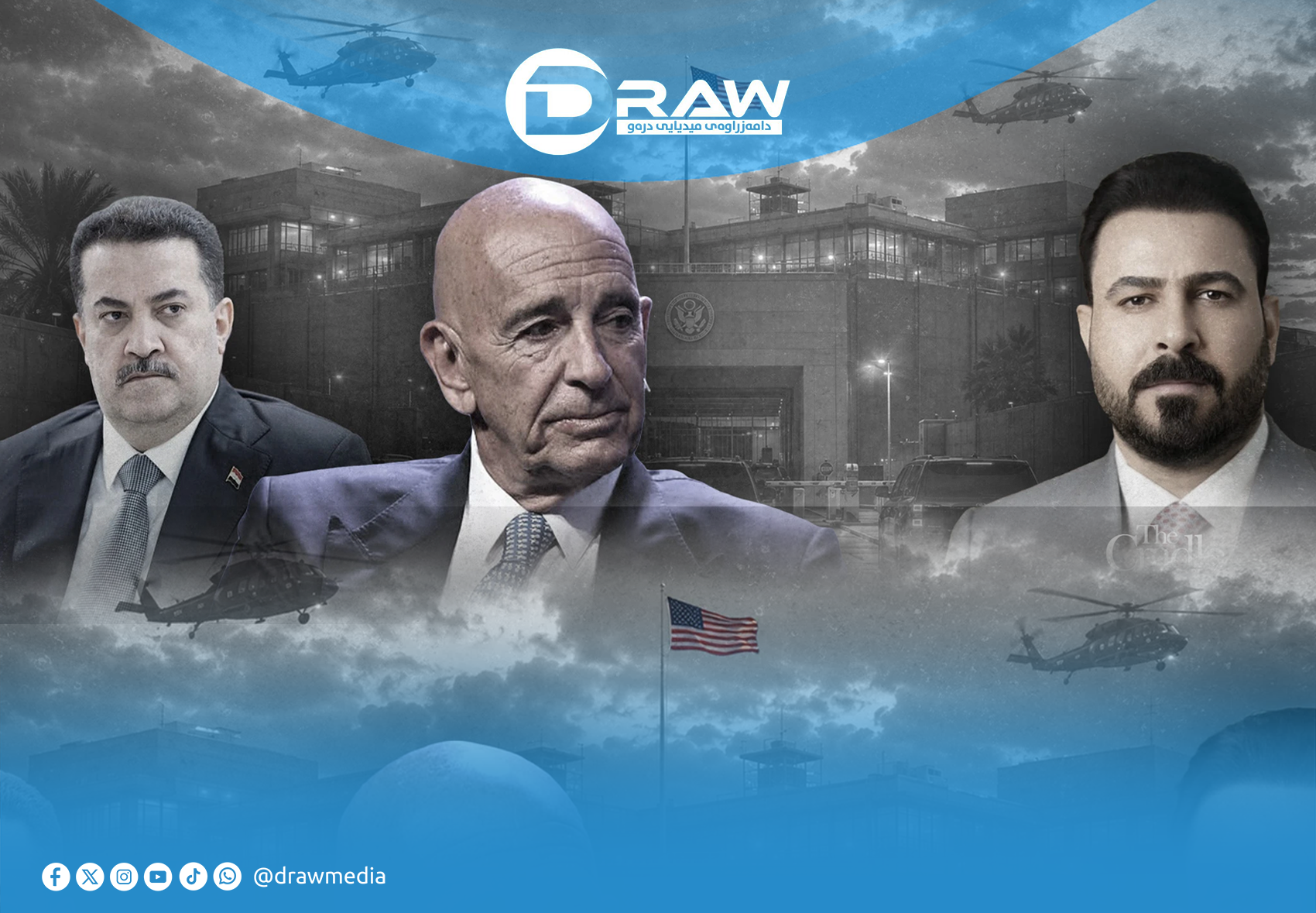
The report, titled "How Washington Is Redesigning Iraq’s Power Structure," alleges that an FBI investigative team questioned Sudani inside the Iraqi government palace in Baghdad’s Green Zone over accusations that he paid money to Mark Savaya in exchange for working to prevent Nouri al-Maliki from returning as prime minister. It further claims that agreements had been reached with around 30 Iraqi political figures as part of a broader political project that also sought to pressure Washington into imposing sanctions on Faiq Zidan, President of Iraq’s Supreme Judicial Council.
Unprecedented Security Deployment in the Green Zone
According to the report, on June 23, Baghdad’s Green Zone witnessed an unusual escalation in security measures, shifting from routine alert status to the highest level of readiness.F
Two helicopters, believed to have been AH-64 Apache gunships, reportedly landed inside the U.S. compound near the American Embassy.
The magazine says the deployment was accompanied by an unusually large presence of U.S. personnel, including FBI agents, around the embassy and opposite the headquarters of the Iraqi Joint Operations Command.
Citing unnamed sources, the report states that the force was deployed to secure an American delegation. Investigators then allegedly traveled in armored vehicles bearing diplomatic license plates, while another team secured the landing site and a bridge overlooking the compound.
The sources suggested that this may have been the first time a newly arrived foreign force assumed responsibility for securing the location, indicating concerns that the delegation could be targeted by drones.
The Savaya File
The report states that the FBI team, accompanied by Iraqi security units, departed the U.S. Embassy in a convoy of SUVs toward the government palace.
Following a meeting lasting approximately one hour, the delegation returned to the embassy compound, located within the same Green Zone sector and separated from the palace by a secured roadway.
According to the sources cited, the investigators’ visit was specifically intended to meet Prime Minister Mohammed Shia al-Sudani and discuss what the magazine describes as a highly sensitive political case involving Mark Savaya, the former envoy of U.S. President Donald Trump to Iraq.
The report describes Savaya as an Iraqi-American businessman with close ties to Trump but no diplomatic experience. He was appointed envoy in October 2025 and left the position by the end of January 2026.
It also notes that Reuters previously reported that Savaya was not an official employee of the U.S. State Department and had not made any official visit to Iraq after assuming the position.
The magazine claims that FBI investigators questioned Sudani regarding allegations that Savaya received Iraqi funds for several objectives, including encouraging Trump to publicly oppose Nouri al-Maliki’s return as prime minister at a time when Washington opposed his candidacy.
According to unnamed American sources cited by the report, the investigation focused on how the money was transferred, which Iraqi parties were involved, and what each side expected in return.
The sources further allege that Savaya received money from Sudani and reached understandings with as many as 30 Iraqi officials.
Barrack Takes Over the Iraq File
According to the report, information emerging from the investigation suggests that the alleged funds were part of a broader political initiative.
The magazine claims that Savaya had been tasked with establishing a lobbying group close to President Trump aimed at pressuring Washington to impose sanctions on Faiq Zidan, head of Iraq’s Supreme Judicial Council.
However, the report says that Zidan had already developed a strong relationship with Tom Barrack, the U.S. ambassador to Turkey and presidential envoy to Syria, who later assumed responsibility for the Iraq portfolio.
According to the sources cited, Barrack informed Zidan about Savaya’s alleged efforts and told him that an Iraqi party was behind those attempts.
The magazine argues that these developments explain subsequent events. It says that Savaya’s removal did not reduce U.S. influence in Baghdad; instead, responsibility for Iraq was transferred to a more influential official with direct access to President Trump and a broader role in West Asian affairs.
The report adds that under Barrack’s leadership, Washington began dealing directly with Iraq’s political transition, reducing the room for maneuver previously enjoyed by Iraqi political factions, which had traditionally maintained separate channels of communication with Washington.
The magazine concludes that the Savaya affair, whether the allegations are ultimately proven or not, reflects a familiar pattern in which Iraqi political actors relied on personal relationships, political lobbying, and mutual promises to strengthen their influence.
According to the report, Barrack’s appointment placed those channels under the supervision of an envoy with broad negotiating authority across multiple regional issues, making Washington the actor that determines the rules of Iraq’s political game and decides who gains access to the White House.