Returning to the Kirkuk Line
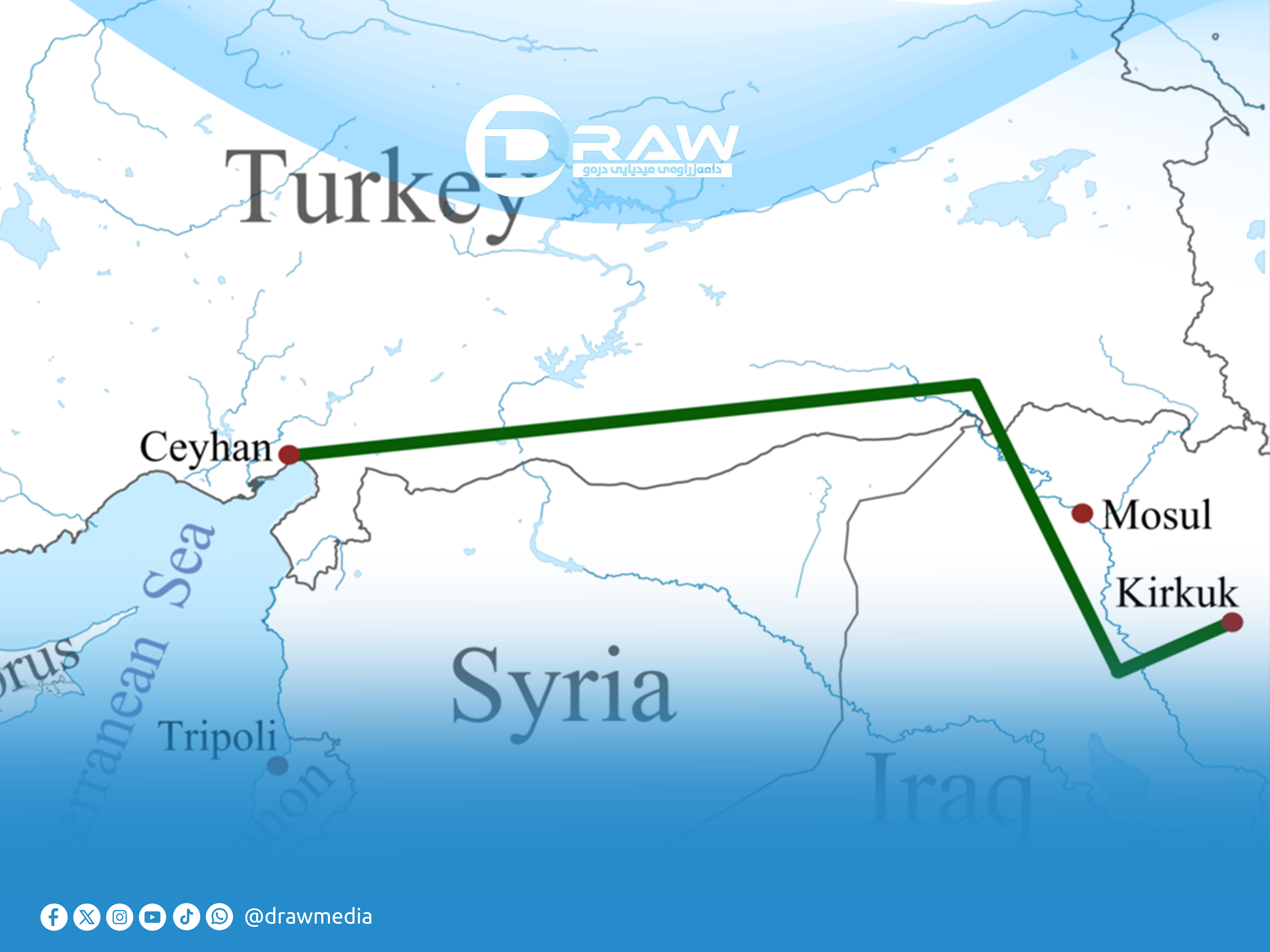
After accusing the Kurdistan Region of blocking the export of Kirkuk oil through the Kurdistan pipeline, Iraqi Oil Minister Hayan Abdul-Ghani announced that Iraq would begin exporting crude oil from the Kirkuk fields to Turkey’s Ceyhan port without passing through the Kurdistan Region’s pipeline.
He said the pipeline has a capacity of 200,000 to 250,000 barrels per day and is currently undergoing final inspections.
The idea of reviving the Kirkuk–Ceyhan pipeline is not new. Since April 2024, the Iraqi government has been working to export Kirkuk oil through Mosul.
If this effort succeeds, Kurdistan Region oil may eventually also be directed to this new route. Kirkuk would find its own export route without relying on the Kurdistan pipeline, leaving the future of the region’s pipeline and oil exports uncertain.
Exporting Kirkuk Oil Without Kurdistan
In April 2024, a knowledgeable source in Kirkuk told Draw Media that Iraq’s Ministry of Oil had conducted its first test of the pipeline that would send Kirkuk oil directly to Turkey’s Ceyhan port.
The tests reportedly succeeded at three pipeline stations.
On June 17, 2014, then-KRG Natural Resources Minister Ashti Hawrami announced the connection of the Kirkuk oil fields to the Kurdistan Region’s new pipeline. At that time, following the arrival of ISIS militants, Iraqi forces withdrew from Kirkuk and Kurdish Peshmerga forces filled the security vacuum and took control of the oil fields.
From then on, Kirkuk oil was exported through the Kurdistan pipeline to Turkey.
Baghdad opposed this move. On July 11, 2014, Iraq’s oil minister accused the Peshmerga of seizing two major Kirkuk oil fields, calling it a “threat to Iraq’s national unity.”
Despite the disagreement, a later agreement allowed Kirkuk oil to continue flowing through the Kurdistan pipeline to Turkey at a rate of about 90,000 barrels per day, until Kurdistan’s oil exports were halted.
On March 25, 2023, exports from the Kurdistan Region were suspended following a ruling by the International Arbitration Court in Paris, which also halted the export of Kirkuk oil.
On March 21, 2024, Draw Media revealed Iraq’s attempt to export Kirkuk oil outside the Kurdistan pipeline. This came while the KRG and the Iraqi federal government were negotiating solutions to resume oil exports to Turkey, particularly over production costs in Kurdistan, which had caused dissatisfaction among foreign oil companies.
A New Route for Oil Exports
Iraq’s Ministry of Oil now wants to reactivate the Kirkuk–Mosul–Turkey pipeline as an alternative to the Kurdistan pipeline.
This pipeline has a capacity of more than one million barrels per day.
The system consists of two pipelines:
One with a diameter of 40 inches
Another with a diameter of 46 inches
Together they can transport 1.6 million barrels per day.
The pipeline begins at the K1 oil field in Kirkuk, passes through Talward, Riyadh in Hawija, Baiji, and Fatha near Mosul, and reaches the MS station west of Zakho, where officials from the North Oil Company measure the exported oil twice daily.
History of the Pipeline
Engineer Farhad Hamza of the North Oil Company explains that Iraqi officials had sought an alternative export route besides Syria since the monarchy era, but political factors delayed the project.
After the Ba’ath Party took power, Iraq nationalized its oil industry in 1972, taking control from British companies.
On December 26, 1974, Iraq and Turkey signed an agreement to establish the Iraq–Turkey pipeline.
Construction began on April 7, 1975 by the German company Mannesmann. The project involved a 40-inch pipeline with a capacity of 750,000 barrels per day.
The pipeline length is 985.3 km:
345 km inside Iraq
640.3 km inside Turkey
It runs from near Kirkuk to Zakho and then into Turkey, eventually reaching Ceyhan port in the Adana region.
The pipeline was inaugurated in January 1977 with a major ceremony attended by Turkish Prime Minister Suleyman Demirel and Iraqi officials.
In 1986, a second 46-inch pipeline was added, increasing total capacity to 1.6 million barrels per day.
At its peak during the 1980s, it exported up to 1.6 million barrels daily.
Iraq paid Turkey transit fees per barrel:
$0.42 per barrel if exports exceeded 1.5 million barrels
$0.75 if exports fell below 750,000 barrels
After 2003, the fees were revised:
$0.70 if exports exceeded 400,000 barrels
$1.12 if exports fell below 200,000 barrels
Failure of the Kirkuk–Baniyas Pipeline Plan
After Kurdistan’s exports were halted, Iraq initially considered reviving the Kirkuk–Baniyas pipeline through Syria to reach the Mediterranean.
Technical teams were assigned to rehabilitate the Iraqi section of the line between Kirkuk, Baiji, and Haditha.
The pipeline was originally built in 1934 with a 12-inch diameter, exporting about 85,000 barrels per day. Later expansions added larger pipelines.
However, Iraq stopped exporting through Syria in 1982 due to Syria’s support for Iran during the Iran–Iraq war.
Today the pipeline requires extensive reconstruction, particularly inside Syria where 850 km of pipeline would need rebuilding.
A 2007 agreement between Iraq and Syria to rebuild the line with the help of a Gazprom-affiliated Russian company collapsed in 2009 due to high costs and other issues.
The Kurdistan Oil Pipeline
Construction of the Kurdistan Region’s oil pipeline began in 2010, and by late 2013 oil exports from the region began flowing to Ceyhan port in Turkey.
At the time, the KRG government led by Nechirvan Barzani described the project as part of “economic independence.”
The pipeline was built by the KAR Group, which owns 40% of it. The construction cost was around $600 million.
Another 60% stake was sold to the Russian company Rosneft.
On June 2, 2017, in St. Petersburg, a deal was signed between the KRG and Rosneft giving the Russian company a 60% share for $1.7 billion, strengthening Russia’s presence in the Kurdistan energy sector.
At the time, Kurdish leaders were concerned about U.S. opposition to the Kurdistan independence referendum, which pushed them closer to Russia.
The Kurdistan pipeline is 896 km long, starting from the Khurmala field and passing through Erbil, Bardarash, Ain Sifni, Jabal Kand, Alqosh, Duhok, and Slevani, eventually reaching Fishkhabur.
221 km (25%) of the pipeline is inside the Kurdistan Region.
675 km (75%) runs inside Turkey to the Ceyhan port.
The Turkish section is operated by the Turkish energy company BOTAŞ.
According to financial reports from Rosneft’s Singapore branch dealing with Kurdistan, the company even paid $250 million to an external consultant to secure its oil agreements in the region.