
هەواڵ
ڕاپۆرت
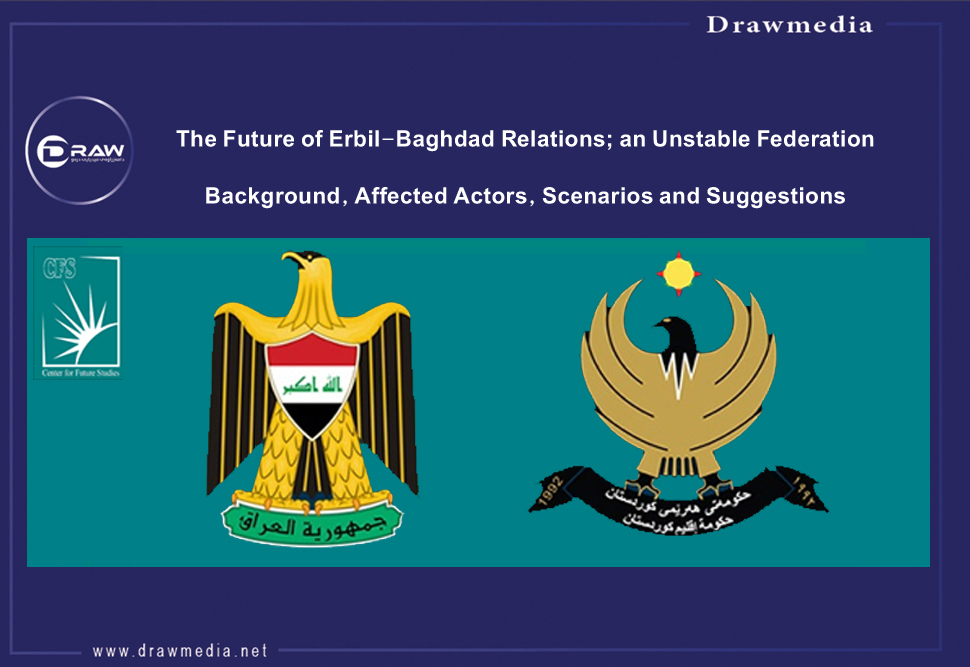
The Future of Erbil-Baghdad Relations; an Unstable Federation
بڵاوکراوەتەوە لە : 9 نیسان 2021
قەبارەی دەقەکان
قەبارەی دەقەکان
هەواڵ
ڕاپۆرت
بڵاوکراوەتەوە لە : 9 نیسان 2021
قەبارەی دەقەکان
قەبارەی دەقەکان
DRAW:
Futuristic Readings - Centre for Future Studies
Section One: Background and the nature of the relationship:
Section Two: The primary viewpoints and actors:
Section Three: Scenarios and Recommendations
The relationship between Erbil and Baghdad are subject to many obstacles. Due to the nature of the relationship and the parties’ polarized and shifting positions, the two sides have thus far failed to resolve their difference and reach a final settlement on the shape of their bilateral relationship on the national, regional and international levels. Falling short of that they have even failed to resolve their deadlock and remedy their respective concerns. The burden of the decades-long unstable relationship between them has fallen mainly on the shoulders of residents.
The relationship between the Kurdistan Region of Iraq (‘KRI’) and Federal Iraq remains problematic without any scope of further separation between the two jurisdictions. In this state, both Erbil and Baghdad cannot forego one another and must continue working together. Hence, both sides continue their efforts to resolve the complex issues that tint their relationship.
During the initial negotiation to repair their fractured relationship analysts perceived a level of understanding between the two sides’ negotiating teams. Hence, following the legislative phase of Iraq’s 2021 budget, analysts expect the relationship between them to transition to a new stage. For this reason, Ranan dedicates issue eight to a discussion into the background, main perspectives, and influential actors of the relationship. It concludes by resenting potential scenarios and recommendations for the relationship going forward.
The relationship between Erbil and Baghdad is not only dependent on the governments of the day. Hence, it would be an oversight to believe that a government change in Iraq or the KRI would provide new hopes for restoring the relationship. The complexities of the relationship and its mounting problems have become protracted. Issues the relationship have often resolved through temporary fixed. In the absence of temporary solutions, problems have been left unresolved for long periods. Occasionally, even these interim measures have caused further disagreements between the two sides and added additional strains to the relationship. The challenging relationship between the Kurdistan Liberation Movement and Iraq is almost at its hundredth anniversary. Still, some of the movement’s original demands of Iraq, which established 1920 without the Kurdish region, have yet to materialize. Over this time, regardless of Iraq’s changing ideology and governance, from British mandated and colonial rule through four regime changes (mandate, monarchy, central republic and federal republic), it has continued to turn a blind eye to Kurdish demands. Iraq’s Kurds continue to have many of the same demands, while flag bearers for the same opposition to the Kurds remain in Iraq. As such the Iraqi political position runs in parallel to that of the KRI.
More recently, it has been eighteen years since the collapse of the Iraqi Ba’ath party regime, and sixteen years since the passing of Iraq’s new constitution. However, the nature of Iraq’s post-2003 political system has yet to cement. While Article One of the Iraqi constitution describes Iraq as a federal state, the experience of the last 16 years has revealed that at no time have the three main ethnic groups that make up the country agreed on how to administer a “federal” Iraq. The Kurds alongside Iraq’s Shi’a community were the main parties that shaped post-war Iraq. However, these two Iraqi communities’ relationship has become more complex, colder, and acrimonious, threatening Iraq’s integrity.
The source of the problems between the two communities is not merely fiscal. The current state of play was neither the will of the Kurdish Political Movement nor the Iraqi sides’ desired outcome. Instead, both sides’ anxiety, fear, and rejection have led to the current state of their relationship. It has prevented them from reaching a resolution that would restore their relationship and avoid it degrading to this point again.
There have been many ups and downs in past attempts at shaping the relationship between the Kurdistan Regional Government (‘KRG’) and the Iraqi Federal Government (‘IFG’) which have come in many forms. (Bilateral – Kurds and the British, trilateral – Kurds, Arabs and English, Iraqi bilateral – Kurds and the 1958 Iraqi republic, Kurds and the Ba’athist Republic of March 1970, international – Kurds and the 1991 international coalition that established a Kurdish autonomous zone in Iraq, and a new trilateral – Iraq, the US and the KRI.) Under US observation, the new trilateral proved to be the most influential attempt as it enshrined the principle of Iraqi federalism and Kurdish rights into the Iraqi constitution. It ushered in a new era of understanding, which between 2003 and 2014, established a largely stable framework for a relationship between Erbil and Baghdad. However, since 2017 the relationship’s development stalled and even retracted on the political, security and economic levels, It was limited to the budget and short-term laws such as loans. Today, the Iraqi constitution remains vital to the Kurds, and they want it to be the foundation of a restored relationship between them and Iraq. However, a viewpoint that has emerged on the Iraqi side (which has been espoused by several sides in Iraq) is that the Iraqi government amends the Iraqi constitution to restrict the KRIs powers. An acceptance of one another and a mutual will to end the problems between them must guide the relationship, the thinking underpinning it and outcomes of any negotiations. Turning a blind eye to issues and leaving them for future generations to resolve, which will only conclude in further humanitarian and financial cost as well as instability and ruin for both sides.
The problem in post-2003 Iraq:
The 2005 Iraqi constitution was drafted primarily under the influence of Iraq’s Kurdish and Shi’a communities. The Kurds enshrined federalism in the Iraqi constitution, which was one of the community’s primary aims. Regardless of this success, since its drafting, some Kurdish issues remained unresolved. For example, Iraq has not managed to resolve Kirkuk’s status and that of its other disputed territories. Furthermore, while Baghdad has indirectly accepted responsibility for financing the Peshmerga, which are formally a component of the Iraqi military, the problem of Peshmerga and even KRI finances have yet to be cleared up in the constitution. As a result, the status of Iraq’s disputed territories, Peshmerga finances, and the successive post-2005 budgets have become the current face of the relationship’s ongoing problems. These problems have on occasion even brought the two parties to the brink of confrontation.
On another front, after locating large reserves of oil and gas in the KRI, in 2007 the Kurdistan Parliament passed the KRI’s Oil and Gas Law to the dissatisfaction of the IFG, who has yet to pass a law to regulate Iraq’s oil and gas sector. Consequently, the administering of oil and gas in the country has become another contention point between Erbil and Baghdad. Iraq reacted tot the passing of the Kurdish law by cutting the KRI’s share of the Iraqi budget in 2014. The KRI responded by selling oil to international markets independent of the IFG.
On 16 October 2017, following the KRI’s independence referendum and Baghdad’s subsequent takeover of Kirkuk and the other Iraqi disputed territories, an atmosphere of complete mistrust developed between the two sides, further straining the already troubled relationship. The focus of the troubles between the two sides quickly shifted to economic matters after due to the depressed international oil price that had left both economies in crisis. The two sides asked questions around how much oil the KRI should hand over to Baghdad and how it should do so in a mutually beneficial way, the KRI’s share of the Iraqi budget going forward and the KRI’s access to hard cash, Iraq’s international loans and other political opportunities that the IFG was able to take advantage of but the KRI couldn’t.
The basis for Iraq’s withholding of the KRI’s share of the Iraqi budget is the KRI’s oil policy, particularly its insistence on selling oil independent of Baghdad and not sending the payments to the federal government. Articles 111 and 112 of the Iraqi constitution outlines that Iraq has ownership and administration rights to oil wells discovered in Iraq before 2005. The articles stipulated that these wells were to be administered by the IFG and the regions and provinces together. However, the ownership and administration rights of oil wells discovered after 2005 is unclear. Analysts expected that lawmakers would draft a new law soon after the constitution passed to set out the ownership and administration rights for the post-2005 wells, but no such law has been approved to date.
The IFG twice (2007 and 2011) attempted to establish an Iraqi oil and gas law; however, it failed on both occasions as the Iraqi lawmakers couldn’t reach agreement on the bill’s contents. The administration rights of oil-producing Iraqi regions and provinces was the main point of contention that led to the bills’ failure. Ultimately, the KRI supported by its own 2007 Oil and Gas Law and in the absence of a federal law began administering its oil and gas production independently, further deepening Baghdad’s divide.
Primary viewpoints:
Before identifying the most influential actors in the dispute between Erbil and Baghdad, it is better to explain the two primary perspectives that have most influenced the relationship between them.
First viewpoint:
The KRI’s primary view of the relationship is that Iraq must be prevented from becoming a centralized nationalist, ideological, or sectarian state. Its secondary viewpoint is that while the Kurdish political movement has not historically faced issues when operating within its four current provinces, they have encountered problems operating in Kirkuk and the Iraqi disputed territories. From the period of British colonialism to its current Shi’a rulers, whenever Iraq’s leaders have denied the Kurdish political movement the right to operate in Kirkuk, the relationship between the KRI and Iraq has failed. Successive Kurdish political movements have flagged these two concerns as “red” because the Kurds, to an extent, believe that they both lead to the same negative outcome for the KRI. When any new development or crises arises in Iraq, Iraqi governments are quick to sweep Kurdish rights aside. Furthermore, the KRI attempts to normalize Kirkuk and the Iraqi disputed territories’ status, even when based on the constitution, are viewed instantly by Iraq and its regional allies through a centralized security prism and rejected. More than negatively impacting Baghdad and Erbil’s relationship, in the past, this issue has forced military confrontations and attempts to reduce the KRI’s national influence.
Second viewpoint:
The primary Iraqi view, which the IFG and the majority of Iraqi parliamentarians espouse is that the making concessions to the KRI may lead to the region becomes too much of a burden on the Iraqi state. Iraq’s fear of territorial dismemberment through the KRI’s separation is the primary driver of this viewpoint. This fear has been the primary influencing factor on Baghdad’s approach to its relationship with Erbil. This Iraqi view manifests in several different ways. For example, Baghdad has numerous working understandings for the term federalism, which differs from its widely accepted definition. For instance, some in Iraq understand it to mean the further empowerment of Erbil, while others understand it to be a way to maintain Iraqi unity. Baghdad’s understanding of federalism is rooted in its fear and anxiety of the KRI and not in the widely accepted international definition of the term, which is based on obligations, rights, mutual compliance, and resource and power-sharing.
Influential actors:
The most influential actors in the relationship between Baghdad and Erbil are the Iraqi state institutions (government and parliament). Decision-makers in Baghdad, especially those post-2017, have a strong desire to expand the central government’s powers over the country’s regions and provinces. Although the IFG’s announced its intention to dissolve the Iraqi provincial councils as an anti-corruption measure, it was also a means to reduce local governments’ power. This desire is evident in the current parliamentary discourse amongst Iraq’s younger generation of leaders and political party leaders.
This viewpoint’s primary thinking is that only when the central government is strong can Iraq achieve security and economic development. Proponents openly criticize and attempt to amend articles in the constitution that empower Iraq’s regions and provinces.
Furthermore, the Iraqi prime minister’s weakness in the Iraqi parliament and the presence of regional and international forces in the country means the Iraqi government does not have the necessary support to resolve Iraq’s main problems. This is as true for the problems in central and southern Iraq, as it is for the disputed territories and the KRI.
Furthermore, with the Iraqi elections fast approaching, Shia political forces currently dominate the Iraqi parliament and dictate the government’s direction. Therefore, for these Shia groups, a weak prime minister is favourable. To maintain his premiership, it is not in the prime ministers’ favour to resolve the relationship between Erbil and Baghdad’s, nor is he powerful enough to do so.
The direction of Iraqi and federal thinking regarding the administration of Iraqi oil is another obstacle to the restoration of relations; this has four sources:
For the last 15 years, the KRI’s economic policy-making has mostly been independent. Kurdish leaders believed that this economic policy was in keeping with the Iraqi constitution, especially in keeping with Articles 102, 114 and 115. The KRI’s semi-independence economically was believed to be a guarantor of the region’s semi-independence politically, and a means to prevent the area from once again falling under Baghdad’s rule. Initially, the different political sides were not in agreement over the policy of an independent Kurdish economy as some believed it would cause trouble with the government in Baghdad. However, the supporters of the policy were dominant and thus became formal KRG policy.
Since the IFG cut the KRI’s share of the Iraqi national budget, this policy has faced significant criticism. Furthermore, declining Kurdish income due to the fall in the international oil price has weakened the KRI’s position with respect to Baghdad.
A more detailed understanding of the Kurdish position in respect to oil reveals four distinct perspectives, which are influential factors in the relationship between Baghdad and Erbil:
It is no secret that Iraq and the Kurdistan Region are territories for regional and international powers to play out their rivalries. In Iraq, the United States and Iran are key players, but other actors such as Turkey, Europe, Russia, and Saudi Arabia also wield influence. The existence of these rivalries in Iraq, spurred on by international terrorist groups in Iraq’s different regions, has split Iraq between the influence of different international poles. As a result, the relations between Erbil and Baghdad have always been influenced by these foreign actors. These actors have sometimes worked to improve relations, while at others they have aided in the souring of relations.
Scenarios:
To understand the negotiations’ outcomes and to show the real picture, the possible scenarios for Erbil and Baghdad’s relationship must be put forward. It may be the case that in the parliamentary discussions on the 2021 budget law, the KRI has managed to guarantee its share in principle. Yet, as the Iraqi parliament continue to discuss the law, there is a significant possibility that the components of the law that are specific to the KRI’s share of the budget may fail to gain parliamentary approval as per the IFG’s recommendations. Therefore, this issue’s future depends on political agreement, political will, and political understanding of both the KRI and Iraqi sides. The option that most benefits both sides is that discussions and negotiations continue and as they do, the following scenarios are possible;
Scenario 1: Agreement
Both parties in the negotiations want to reach agreement t resolve their deadlock; however, there are disagreements on the finer details. The proposed Iraqi budget is acceptable to the KRI, as, to an extent, it does not go against the principles of the Iraqi constitution and the rights of both sides to jointly administer Iraq’s natural resources. In the negotiations, this issue of the budgets compliance with the Iraqi constitution and joint rights to manage Iraq’s natural resources is promoted more by the KRI’s negotiators as it is considered one of the regions most vital negotiating points. For its part, the IFG is demanding that the KRI comply and show goodwill by handing over its oil to SOMO Company, Iraq’s national oil administrator.
Two possible outcomes can result from an agreement;
Scenario 2: No Agreement
This scenario rests on the assumption that the IFG requires that the KRI hand-over control all its oil infrastructure and revenue, a demand that some Iraqi parliamentarians are currently pushing as pre-election rhetoric as a pressure card against the Kurds. These parliamentarians support their demands by pointing to the IFG’s regular complaints that oil exported independently by the KRI hurts the Iraqi economy. The IFG protests that Kurdish crude is sold at discounted costs and have a production cost of $20 per barrel. Furthermore, it alleges corruption and a lack of transparency in the Kurdish oil sector. Therefore, these parliamentarians want to see Kurdish oil and gas administered by the IFG. However, the KRG believes these calls to be a disregard for the Iraqi constitution and an attempt to weaken the KRI’s status. Erbil perceived these views to represent movement towards centralised governance in Iraq and the KRI’s treatment as an Iraqi province.
In the event that no agreement is reached the following outcomes are possible.
Scenario 3: Mediation
To reach a mutual understanding with the IFG before the 2021 Iraqi budget law passes, the KRI may look to a third-parties to mediate the negotiations. The likely parties for mediation are the United Nations, the United States or Iran. For this scenario, the KRI must act quickly before the window for this option expires (if It has not already passed).
At present, the most likely scenario is the second – no agreement. The Iraqi parliament will likely not be satisfied with the IFG’s recommendation and demand that the KRI hand over all of its oil infrastructure and oil revenue to SOMO Company. For its part, the KRI will likely refuse this request, as the reasoning behind accepting the demand is from the Kurdish perspective against the Iraqi constitution.
Suggestions and Recommendations:
To resolve the problems between Erbil and Baghdad and to prevent the issues from becoming a cause for further foreign interference, political instability, and insecurity in Iraq and the KRI, the following recommendations are vital:
Both sides agree that the Iraqi constitution should form the foundation of their mutual understanding and their resolutions. Therefore it is recommended that both sides focus their efforts on resolving the ongoing problem with the Iraqi oil dossier and the national budget. The two sides can achieve a resolution by utilising Articles 111 and 112 of the 2005 Iraqi constitution and learning from the experience of other developed federal systems. Ranan recommends one of the following:
Both regional and international forces in Iraq should play a positive role in resolving Erbil and Baghdad’s underlying issues. The current reality in Iraq and the KRI is that foreign powers ae present and influence the relationship. Therefore, to create an encouraging environment for the two sides to enter into in-depth multilateral negotiations, foreign forces should stop using Iraqi and KRI soil to settle their international rivalries. Instead, these powers should help create conditions for mutual understanding between the Erbil and Baghdad on a win-win principle. If foreign powers continue to use Iraqi and KRI soil to play out their rivalries, this will weaken Baghdad and Erbil. A weaker Iraq will make conditions in the country rife for the re-emergence of extremist groups like ISIS and Al-Qaeda. Here, the US, Iran and the UN can play a central role. Through the UN, or bilaterally, the US and Iraq can restore mutual trust between Erbil and Baghdad.