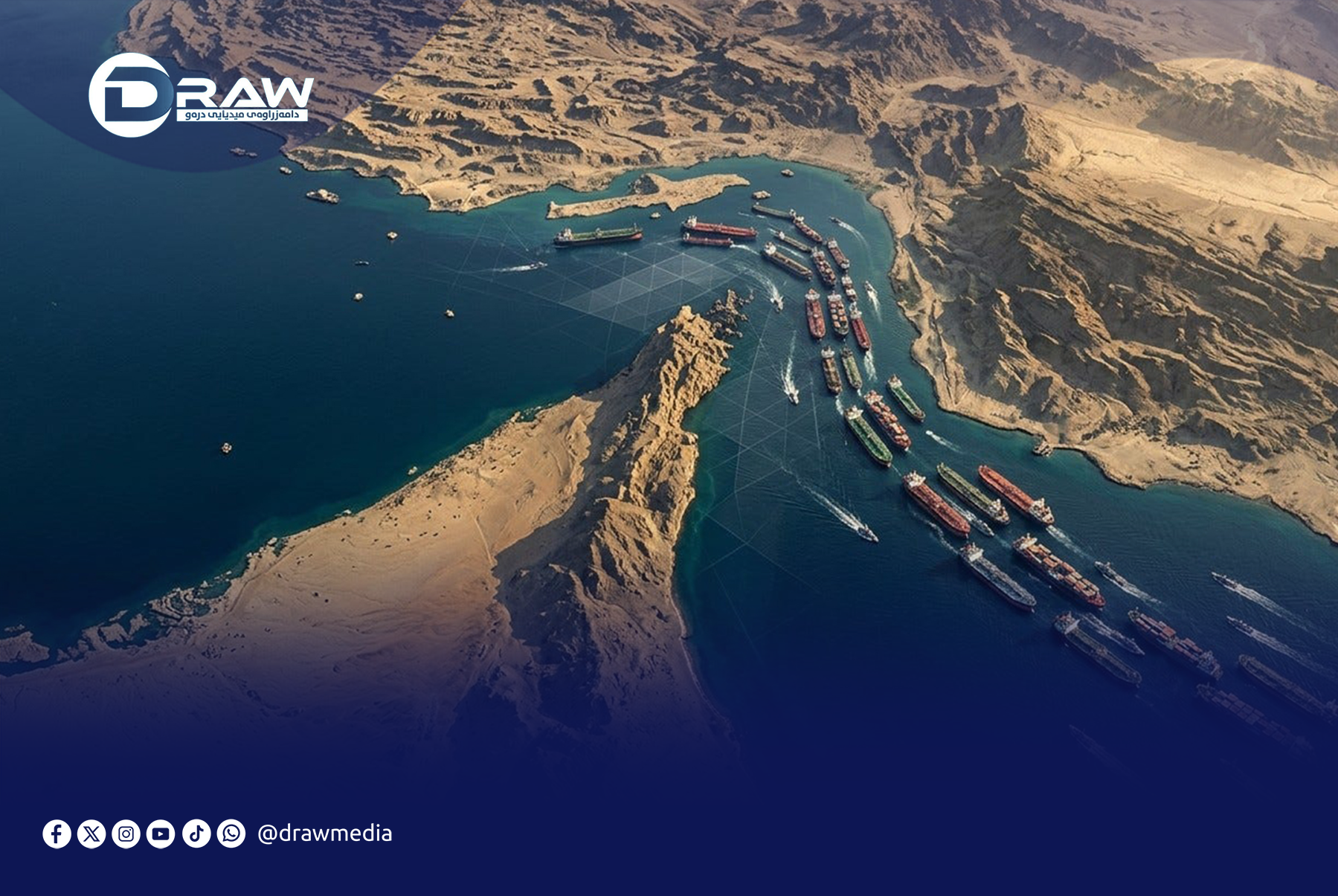
A data analysis prepared by the Data Journalism Department of Al-Saa’a Network showed that the main risk is not limited to a temporary decline in exports, but rather Iraq’s limited ability to find alternative routes that ensure its oil continues to reach global markets. Developments have also exposed the fragility of an economic model that depends heavily on oil revenues to finance the budget, making any disruption to export channels quickly affect the state’s financial resources.
Export Routes and Their Impact on Financial Resources
Iraq relies primarily on its southern ports to export crude oil. Before the crisis, they accounted for around 97.7% of total exports, making the Iraqi economy highly dependent on maritime traffic through the Strait of Hormuz, through which approximately 93 million barrels per month passed.
With the outbreak of the regional crisis between Iran, the United States, and Israel, maritime traffic through the strait was disrupted. Exports through it fell to around 10 million barrels in April 2026, a decline of approximately 89%. This led to production falling to around 1.4 million barrels per day due to storage facilities becoming full. The monthly export shortfall reached approximately 83 million barrels, meaning Iraq was unable to export around 2.77 million barrels per day because of difficulties in marketing its oil.
Amid this situation, the Turkish Ceyhan pipeline became an alternative export route, but its capacity remained limited. Exports through it did not exceed 200,000 barrels per day in May 2026, while overland transportation to Jordan remained limited.
Heavy reliance on a single export route has increased the exposure of Iraq’s oil revenues to shipping disruptions, higher insurance costs, and the risk of a potential closure of the Strait of Hormuz. This differs from some Gulf states that have alternative pipelines bypassing the strait toward the Red Sea or Gulf of Oman, giving them greater flexibility in maintaining exports.
As revenues declined and export capacity deteriorated, Iraq relied on its foreign reserves, which stood at $93.67 billion in May 2026, as a financial buffer to support stability. At the same time, domestic debt rose to 103.18 trillion dinars, widening the financing gap. Actual expenditures through May 2026 reached approximately 46.70 trillion dinars, exceeding revenues by about 12.95 trillion dinars.
Declining Financial Buffers and Rising Debt (2023–2026)
Official foreign reserves at the Central Bank of Iraq fell from $111.74 billion at the end of 2023 to $93.67 billion at the end of May 2026, a decline of $18.06 billion, equivalent to 16.2%.
At the same time, domestic public debt increased from 70.56 trillion dinars to 103.18 trillion dinars, an increase of 46.2%. Meanwhile, the Ministry of Finance’s claims against the Central Bank rose from 43.90 trillion to 63.20 trillion dinars.
These indicators—which do not mean that reserves were directly spent on salaries—reveal a narrowing financial and monetary buffer as reliance on domestic financing increases.
How Much Can Alternative Export Routes Compensate?
Kirkuk oil exports through the Turkish port of Ceyhan were restarted in March 2026 at an initial rate of 170,000 barrels per day, with an initially announced capacity of up to 250,000 barrels per day. In May, Iraqi Oil Minister Bassem Mohammed Khudair Al-Abbadi said flows through the Ceyhan pipeline had reached around 200,000 barrels per day, with a plan to increase the volume to 500,000 barrels per day.
Under the current crisis, exports of 500,000 barrels per day would amount to less than one-sixth of Iraq’s normal oil export level. Meanwhile, under normal circumstances, overland transportation to Jordan does not exceed approximately 10,000 barrels per day, making it a limited outlet that cannot replace tanker traffic through the Strait of Hormuz.
The Process of Converting Oil into Iraqi Dinars
Iraq’s oil revenue cycle begins with extracting crude from oil fields and then passes through an interconnected series of technical, commercial, and financial processes, including production, measurement, transportation, storage, marketing, and sales. It ultimately ends with converting the dollar value of exports into financial resources used by the state to finance the general budget.
National extraction companies, in cooperation with foreign companies contracted to operate some fields, handle crude oil production and measurement of extracted quantities. The crude is then transported through the pipeline network to collection and storage facilities before being directed either to domestic refineries to cover part of domestic consumption or to export terminals and international pipelines.
The Iraqi Oil Marketing Company, SOMO, is responsible for marketing and selling oil designated for export. This includes determining the quantities offered, buyers, prices, loading schedules, and delivery terms, based on the type of crude, global prices, quality differentials, and transportation costs.
After the oil is loaded onto tankers or pumped through pipelines, the final quantity and value of the shipment are confirmed. The buyer then transfers the value of the oil in dollars to Iraq’s designated external accounts. At this stage, the exported oil becomes actual financial revenue.
Since government expenditures inside Iraq—including salaries, pensions, and services—are paid in Iraqi dinars, the Ministry of Finance transfers part of its oil revenues in dollars to the Central Bank of Iraq and, in return, receives a dinar balance according to the official mechanism and exchange rate in force.
These funds then enter the general treasury accounts and are used to finance ministries, government institutions, and banks, ultimately covering salaries, pensions, social welfare, operational expenditures, and investment projects.
Scenarios for Declining Oil Exports and Their Impact on Revenues
Potential scenarios for declining oil exports show the scale of losses that Iraq’s treasury could face compared with normal export levels. If exports remain at approximately 3.43 million barrels per day, estimated monthly revenue would reach around $8.23 billion, equivalent to 10.70 trillion dinars.
If Iraq manages to export 750,000 barrels per day through available alternatives, monthly revenues would fall to approximately $1.80 billion, or 2.34 trillion dinars, representing a difference of about 8.36 trillion dinars from the normal situation.
Under a scenario of exporting 500,000 barrels per day, revenue would fall to around $1.20 billion, equivalent to 1.56 trillion dinars, bringing the monthly loss to approximately 9.14 trillion dinars.
If exports fell to 200,000 barrels per day, monthly revenue would not exceed approximately $480 million, or 624 billion dinars, while the shortfall would rise to approximately 10.08 trillion dinars per month compared with normal export levels.
The Financial Gap Predated the Impact of the Strait of Hormuz Crisis
The Central Bank of Iraq’s statistical bulletin shows that actual public revenues through the end of May 2026 reached 33.75 trillion dinars, compared with expenditures of 46.70 trillion dinars, resulting in a financial deficit of approximately 12.95 trillion dinars.
The expenditure structure is dominated by current spending, which reached 45.07 trillion dinars, equivalent to 96.5% of total expenditure, while investment spending did not exceed 1.63 trillion dinars. This distribution indicates that the government’s ability to reduce spending is concentrated mainly in postponing or cutting investment projects.
Meanwhile, current expenditures—particularly salaries, pensions, and social welfare—remain difficult obligations to reduce in the short term, limiting fiscal policy flexibility in dealing with crises.
Does the Crisis Threaten Salary Payments?
A halt or decline in oil exports for a single month would not directly stop salary payments, as the government has temporary financing tools, including the use of balances and deposits, issuing transfers and bonds, borrowing from state-owned banks, and postponing some investment expenditures and payments owed to contractors.
Employee compensation, according to 2024 data, amounts to approximately 60 trillion dinars annually, or around 5 trillion dinars per month. If exports remain at 200,000 barrels per day, the monthly loss in oil revenues is estimated at approximately 10.1 trillion dinars.
This amount is roughly twice the value of monthly employee compensation, meaning that continued low exports would require the government to turn to other sources of financing to cover current expenditures, including salaries.
Note: The estimates are calculated based on the difference between normal export levels and the scenario of exporting 200,000 barrels per day, using an oil price of $80 per barrel. They do not include changes in prices or export costs.
The Crisis Reaches the Public
The effects of the Strait of Hormuz crisis are not limited to salaries but extend to various aspects of daily life. Higher shipping and insurance risks increase the cost of imported goods, while reduced oil-dollar inflows create additional pressure on financing foreign trade.
The effects of the crisis spread through an interconnected chain beginning with declining exports and reduced dollar inflows, followed by increased need to finance the deficit and reduced spending on projects, ultimately leading to higher import costs and resulting pressure on prices and the exchange rate.
Indicators Showing the Crisis Is Escalating
The speed at which the financial crisis develops into a broader crisis depends on several indicators reflecting the state’s ability to continue financing its obligations. The most important indicator is the level of daily oil exports. If exports remain below 1 million barrels per day for an extended period, Iraq would lose a significant portion of its oil revenues.
The continued limited capacity of the Kirkuk-Ceyhan pipeline also reflects the weakness of available alternatives. Meanwhile, a widening gap between revenues and expenditures, rising domestic debt, and declining foreign reserves are direct indicators of increasing financial pressure.
At the economic level, a widening gap between the official and parallel exchange rates, delays or fragmentation in salary financing, and widespread increases in food and transportation prices would indicate that the effects of the crisis are spreading from public finances to the economy and citizens.
Conclusion
Iraq faces a challenge in getting its oil to global markets. The disruption of maritime traffic through the Strait of Hormuz has shown that possessing large oil reserves and production capacity does not provide sufficient protection for public finances when exports are concentrated through a single route, particularly when alternative pipelines have limited capacity. Comparisons show that the routes available through Turkey and Jordan cannot compensate for the volume of exports normally shipped through Iraq’s southern ports.
The risk of salaries stopping does not appear to be immediate, as the state can temporarily protect essential spending by relying on balances, borrowing, and postponing some projects. However, if exports remain at low levels for three to six months, the financial gap could rise to tens of trillions of dinars at a time when expenditures already exceed revenues, domestic debt is increasing, and reserves and deposits are declining.
Therefore, pressure becomes more severe when a prolonged disruption coincides with limited alternatives, a widening deficit, and difficulty obtaining financing—not simply because maritime traffic is halted for several days.
The vulnerability of the Iraqi economy can be summarized as its high dependence on oil exports, combined with near-total reliance on southern ports and the absence of export alternatives capable of handling normal volumes. Protecting revenues over the long term requires transforming the northern and western pipelines from backup routes into fully operational export outlets, alongside developing non-oil revenues and reducing the public sector’s dependence on a single source of revenue and a single export route.
Source: Al-ssaa Network