According to a report by Asharq Al-Awsat, citing security and intelligence sources, Iraqi authorities suspect that the explosion earlier this month that targeted a strategic ammunition depot at Taji military base, north of Baghdad, was caused by a drone attack. The sources said the explosion inflicted extensive damage on a depot containing ammunition for tanks and armored vehicles belonging to the Iraqi army.
The incident had previously been described by official authorities as a fire caused by high temperatures.
According to the sources, investigators believe that a drone, whose type has not yet been identified, flew over the base shortly before the ammunition depot of the 9th Armored Division exploded. The blast subsequently detonated a large quantity of armored-vehicle and tank ammunition, including ammunition for U.S.-made Abrams tanks.
Two officers told the newspaper that investigators reviewed the military base's surveillance-camera footage, which showed an airborne object approaching the site from the southern part of the base shortly before the ammunition and tank-shell depot exploded.
One of the officers said, “We lost most of our tank-related equipment and ammunition. The 9th Armored Division now has no ammunition depot—not even a single round—apart from the ammunition currently inside the tanks themselves.”
According to another intelligence officer, the ammunition depot was highly likely to have been targeted by a drone.
Earlier, on August 2, Iraq's official news agency, citing officials from the Ministries of Defense and Interior, reported that a fire had broken out at an ammunition depot inside Taji military base, north of Baghdad, due to high temperatures.
According to the sources, the affected ammunition depot contained approximately 50,000 rounds, constituting the basic ammunition stockpile of one of the Iraqi army's most important combat divisions. However, the actual scale of the losses resulting from the attack has not yet been determined.
The 9th Armored Division is one of the Iraqi army's most prominent formations. Based at Taji, north of Baghdad, the division has a strategic role as one of the army's main intervention units.
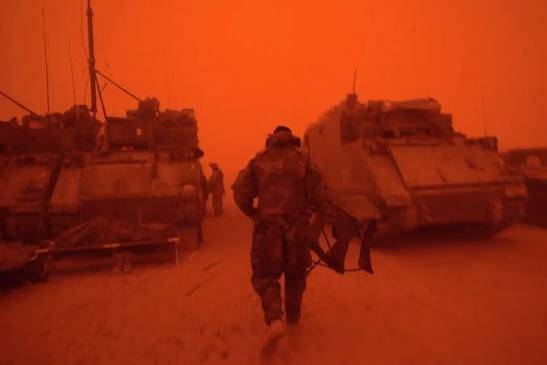
The U.S. origin of the division's armament is particularly evident in its use of Abrams tanks and M113 armored personnel carriers, which form a major part of Iraq's armored capabilities.
Meanwhile, a security source said the attack on the tank and armored-vehicle ammunition at Taji occurred while elements of the 9th Armored Division were redeploying to different areas to provide security for the Arbaeen pilgrimage.
The source added that military commanders were immediately present at the division's headquarters at Taji after being informed of the attack. Military authorities subsequently decided to detain the officers and soldiers responsible for guarding the site, while a military intelligence investigation team arrived to inspect the location.
The newspaper learned that Iraq has recently requested an urgent supply package to replenish its ammunition shortages, including ammunition for U.S.-made tanks and armored vehicles. The request is believed to be linked to compensating for the losses resulting from the Taji incident.
An intelligence official said preliminary investigations concluded that an armed group had used a location south of Baghdad to launch the drone toward its target at Taji military base.
According to security and political officials, the attack points to the continued efforts of armed groups that reject disarmament to weaken the organized security forces by depriving them of weapons and military resources that give them an advantage on the battlefield over irregular armed groups.
The sources said armed groups are implementing pre-planned strategies in anticipation of any confrontation with Iraq's security institutions, with the aim of depriving organized forces of military assets that could give them an advantage in potential battlefield confrontations, including tank ammunition.
A political official within the Coordination Framework said the Iraqi government is engaged in a “silent and sensitive war” with extremist armed groups and does not want to turn it into an open confrontation because of the domestic and regional risks involved.