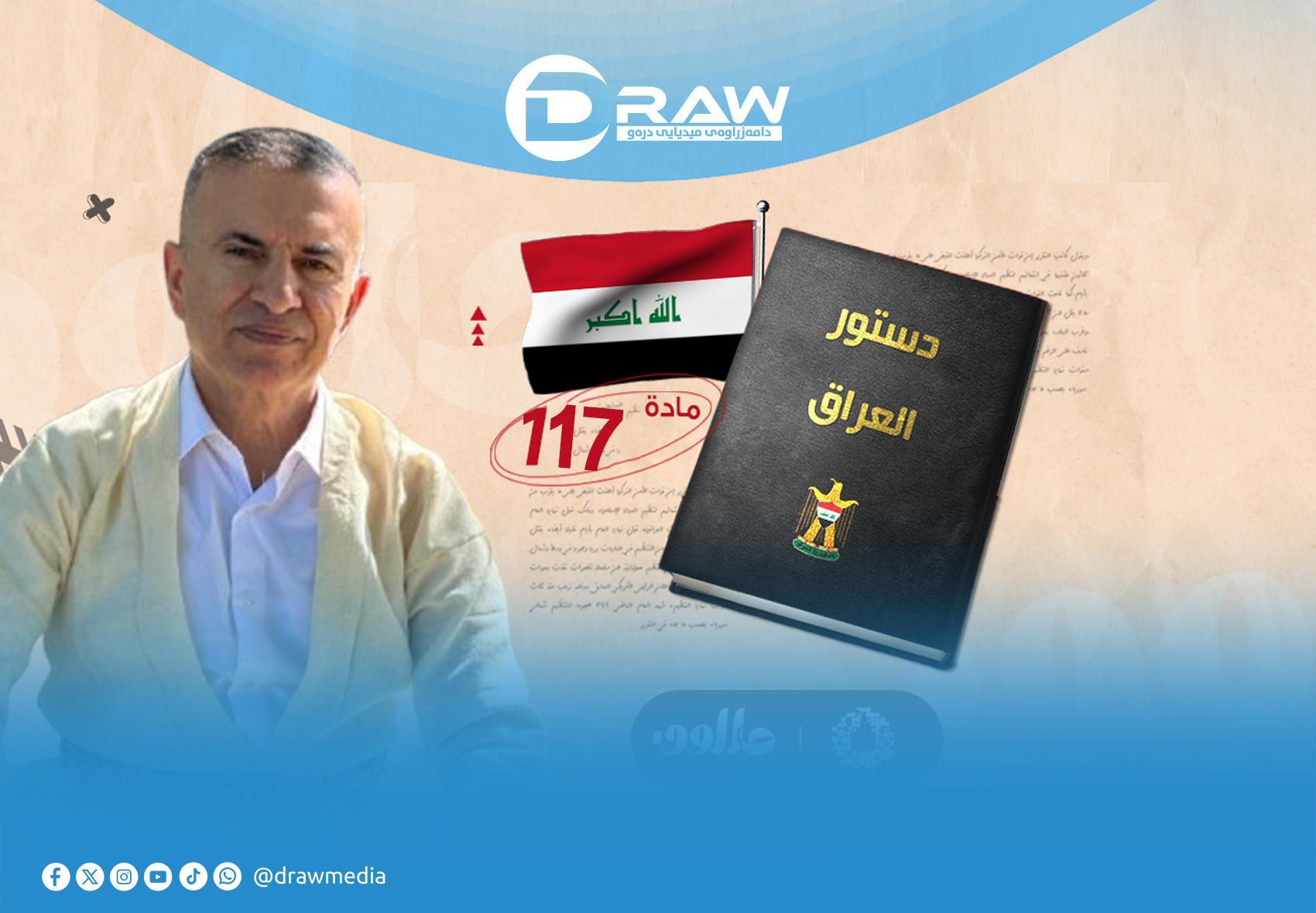
Dr. Latif Sheikh Mustafa
Section Five of the Iraqi Constitution is dedicated to regions, governorates, the capital, and local administration. It consists of four chapters.
First: Chapter One on the Section Five – The Regions
Article 117, paragraph one, explicitly establishes the constitutional status of the Kurdistan Region. It recognizes the Kurdistan Region within its existing boundaries, as they existed de facto before the Constitution was adopted, and acknowledges the powers it exercised as a federal region.
Having established the Region's status, paragraph two states that the Constitution recognizes any new regions that may be established in accordance with its provisions. This refers to Articles 118 and 119.
Therefore, Articles 118 and 119 concern new regions that may be established in the future, as mentioned in Article 117, paragraph two. They do not, in any way, apply to the Kurdistan Region.
We can even argue that the powers granted to regions under Article 121 are intended for newly established regions. The Kurdistan Region enjoys broader powers than those provided for newly established regions because Article 117 explicitly states that the Constitution recognizes the Region and its existing powers.
The term powers has two meanings: an institutional (organizational) meaning and a functional meaning. Accordingly, the Constitution recognizes all the Region's powers, encompassing the legislative, executive, and judicial branches, both as institutions and in terms of their functions and authorities.
It is well known that, at the time the Iraqi Constitution was drafted, the Kurdistan Region's institutions and authorities operated with a degree of autonomy comparable to that of a semi-independent state.
Consequently, based on this article, the relationship between the Region and the Iraqi federal government could, to some extent, be viewed as resembling a confederation rather than a conventional federation under Article 121.
The Region must therefore rely on Article 117 when asserting its powers vis-à-vis the federal government, rather than Article 121, which concerns newly established regions. Article 117 recognizes the extensive powers that the Kurdistan Region already possessed and explicitly acknowledges them.
Second: The Boundaries of the Kurdistan Region
The boundaries of the Kurdistan Region are defined in Article 53(A) of the Law of Administration for the State of Iraq for the Transitional Period. These are the boundaries that existed on 9 April 2003.
Accordingly, the Kurdistan Region is constitutionally recognized as one region within those boundaries, under the name Kurdistan Region.
Any attempt to dissolve it or divide it into several regions would require an amendment to the Constitution, because Article 53(A) has remained part of the constitutional framework by virtue of Article 143.
Baghdad's boundaries are also constitutionally defined under Article 124. Therefore, neither the federal Parliament nor the federal government can divide Baghdad into two or more governorates through ordinary legislation, unlike other governorates, for which such arrangements are possible.
If they wish to divide Baghdad into two or more governorates, they must first amend the Constitution.
The same principle applies to the Kurdistan Region.
As long as Article 143 remains unamended, the Region cannot be divided into two or more regions.
Third: The Intent of the Constitution's Drafters
In a previous post on this page, I discussed the methods of constitutional interpretation, explaining that there are several approaches. One of them is to establish the intention of the legislature at the time the Constitution or law was drafted. This can be done by referring to the official records, protocols, and discussions that took place during the drafting process.
The records of the Constitutional Drafting Committee were published in four volumes and are available in bookstores. Discussions concerning the regions are contained in the fourth volume.
A review of these discussions reveals that not only was there no indication that the governorates within a region could separate in the future and establish another region, but the opposite was actually the case.
All parties, including Shiites, Sunnis, and Kurds, unanimously agreed to recognize Kurdistan as a single region.
Even those who opposed federalism had no objection to recognizing the Region as one entity within its existing boundaries.
Similarly, those who supported the establishment of federal regions based on individual governorates had no objection to recognizing the Kurdistan Region as a single entity.
There is no explicit or implicit indication in these discussions suggesting that the governorates within the Region could separate from it in the future.
This was only natural because Iraq was transforming from a unitary state into a federal one. The general direction was therefore towards recognizing Kurdistan as one region, particularly because the same boundaries had already been recognized under the Law of Self-Administration.
Furthermore, the demand for a federal system had primarily come from the Kurds.
All Kurdish representatives on the Constitutional Drafting Committee supported maintaining the unity of the Region. The possibility of dividing it or separating parts of it in the future had never even crossed their minds.
Fourth: Law No. 13 of 2008 on the Procedures for Implementing the Formation of Regions
When Law No. 13 of 2008, concerning the procedures for implementing the formation of regions, was enacted pursuant to Article 118 of the Constitution, it did not, in any way, provide for the governorates within an existing region to become independent federal regions.
On the contrary, the law contains a provision that points in the opposite direction: Article 2, paragraph three.
This provision establishes procedures through which a governorate may join an existing region. Although it does not explicitly name Kirkuk, the provision primarily concerns the possibility of Kirkuk joining a region, given that the Kurdistan Region was the only existing region at the time the law was enacted.
In other words, the law provided a mechanism for the Kurdistan Region to expand by incorporating another governorate, particularly in the context of implementing Article 140.
However, it did not provide any mechanism or procedure for the governorates within the Region to separate and become independent federal regions.
Fifth: Explicit References to the Kurdistan Region in the Constitution
The name Kurdistan Region is explicitly mentioned in four constitutional articles:
Article 2: Provides that both Arabic and Kurdish must be used in the Kurdistan Region.
Article 117: Explicitly recognizes the Kurdistan Region.
Article 141: Recognizes all laws, contracts, and judicial decisions issued by the Region before the adoption of the Constitution.
Article 143: As previously mentioned, establishes the Region's boundaries.
In addition to these explicit references, the Kurdistan Region is also mentioned implicitly in other constitutional provisions.
For example, Article 140 refers to the disputed territories, describing them as disputed areas between the Kurdistan Region and the federal government.
If Kurdistan were divided, the question would arise: between whom would these territories be considered disputed?
This further demonstrates the constitutional significance of recognizing the Kurdistan Region as a single entity.
The Kurdistan Region, as a single constitutionally recognized entity, has a central status and significant constitutional standing within the Iraqi Constitution.
Dividing it without amending the Constitution would undermine the entire constitutional framework.
Therefore, from a constitutional standpoint, the Kurdistan Region cannot be divided without an amendment to the Iraqi Constitution. Any argument to the contrary is political rhetoric, not a legally grounded position.
May God condemn those who have brought us to a point where some people have come to believe that the Region should be divided.
Clearly, those advocating such a position are undoubtedly in a difficult situation and are suffering from a serious crisis. However, the solution certainly does not lie in dividing the Region. Rather, it lies in holding accountable and removing those responsible for creating this situation in the first place.