Draw Media
Khaled Sulaiman- theamargi
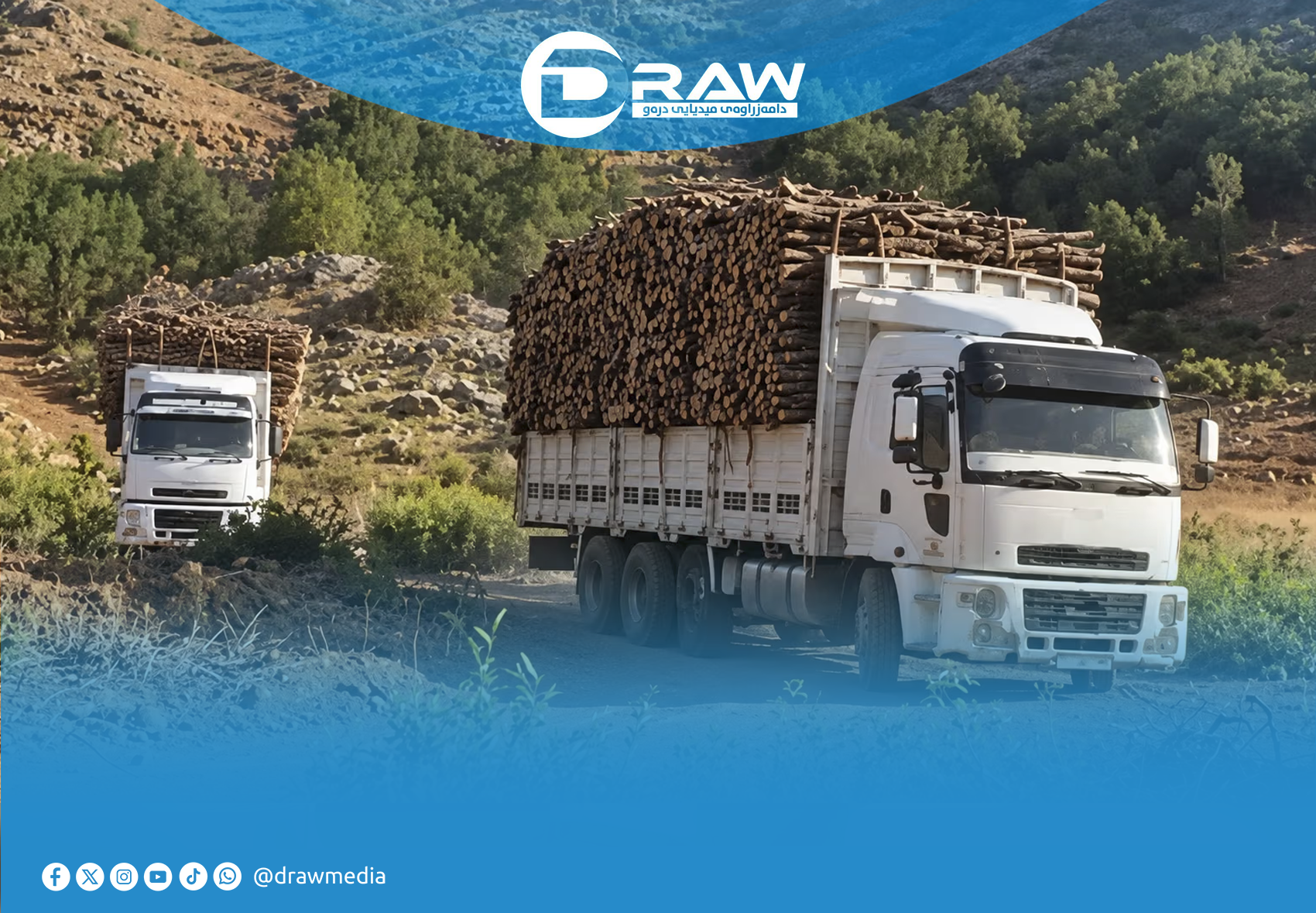
The sharp teeth of Turkey’s saws are bearing down once again on the Kurdistan Region of Iraq. In the mountainous Badinan region, natural forests are being systematically felled and cleared. While Ankara cites military operations against the Kurdistan Workers’ Party (PKK) as its rationale, the reality on the ground points toward a far more expansive strategy: uprooting local communities by destroying the natural environment that sustains them.
Ankara’s official narrative frames the deforestation and the construction of military corridors in Badinan’s heartland as military measures to eliminate the PKK, but a closer examination reveals a policy that transforms fertile, biodiversity-rich ecosystems into forbidden military zones and barren landscapes. It is worth noting that the PKK has halted tree-felling and logging in areas where it is present.
To date, the Turkish military has penetrated up to 40 kilometers into Iraqi territory, establishing more than 100 military bases across occupied enclaves. To link these outposts, forces have carved roughly 660 km of military roads through dense mountain forests. According to Baxtyar Zebari, an environmental journalist and researcher from the Duhok Governorate who has documented military incursions in these mountains for years, the systematic cutting of trees dates back to 2013. Zebari estimates that between 2020 and 2023 alone, approximately three million trees were felled or uprooted.
Map of Turkish military bases and road network in Badinan — Verified by Community Peacemaker Teams (CPT)
The ecological destruction has triggered a human crisis. Thousands of rural villagers have been forced to abandon their homes and agricultural livelihoods. Crucially, as these occupied areas are cleared of cover and population, Turkish forces show no intention of withdrawing.
Official alarm was raised in 2021 when Fahim Abdullah, Head of the Duhok Provincial Council, publicly exposed the scale of tree-felling within the militarized zones. Turkish forces argued that dense forest canopies obstructed military visibility and operations against PKK fighters. In a rare joint response, the Ministries of Agriculture in both Baghdad and Erbil condemned the deforestation, describing the destruction of Kurdistan’s forests as an aggressive, uncivilized act against humanity and the global environment.
The log shipping pipelines date back further. Verified local reports indicate that as early as 2018, the Turkish military established three main supply routes extending into Iraqi territory. These routes served a dual purpose: moving in military hardware and extracting timber out to domestic Turkish markets. Chia Sharif, a member of the Kurdistan Regional Parliament, confirmed in an interview that local traders, including merchants operating along border corridors, were encouraged by military authorities to purchase the felled timber and ship it across the border.
While the full extent of this ecocide only gained wide international attention in recent years, local officials note that the groundwork began around 2015. The core danger lies in the long-term displacement of indigenous populations. In these mountain valleys, human survival is inextricably linked to the ecosystem, sustained by ancient oak forests, groundwater wells, terraced farming, and livestock. When these natural foundations are destroyed, life becomes unsustainable, forcing families to migrate.
This pattern of militarized deforestation is not unique to the Iraqi Kurdistan; it mirrors tactics used across the border in Turkey’s predominantly Kurdish provinces. Huseyin Kacmaz, a former Member of the Turkish Parliament representing the defunct Peoples’ Democratic Party (HDP), publicly documented state-backed timber extraction in Mount Cudi. “Turkish commercial enterprises, working under the protection of village guards and soldiers, are harvesting approximately 400 tons of timber daily from the mountains,” Kaçmaz posted on his X account in 2021.
By degrading the local ecosystem, these practices sever centuries-old agricultural traditions and heritage. The destruction goes beyond environmental damage and fractures the socio-cultural fabric of Kurdish rural life.
History offers stark warnings regarding the long-term socio-economic fallout of deliberate deforestation. A dramatic historical parallel can be found in Haiti. Following its independence from French colonial rule in 1804, the newly independent nation was forced to pay an exorbitant indemnity of 150 million gold francs to France (15 billion euros at today’s rate). To service this staggering debt, Haiti began clear-cutting its rich forests for timber exports. Once covered in lush forests of mahogany, coconut, and hardwood across 80% of its territory, Haiti’s tree cover stands at less than 2% today, a historical environmental tragedy that laid the groundwork for severe, enduring poverty.
Stripping the mountains of Kurdistan of their forests heralds a long-term trajectory similar to what occurred in Haiti over two centuries ago: transforming resilient rural ecosystems into barren wastelands, depriving local communities of their self-sufficiency, and reshaping the region’s demographic and environmental landscape.
Khaled Sulaiman
is the author of Water Guards: Drought and Climate Change in Iraq, and Edge.. Hidden Sides of Climate Change. He has worked for more than 15 years with regional and international media platforms on water and climate crisis impacts in the Middle East, with the aim of strengthening the role of the media in addressing the effects of climate change. Khaled Sulaiman has published various investigative articles and books, in Arabic and Kurdish, about the impacts of global warming on humans and ecosystems in the MENA region. He writes for the DARAJ me