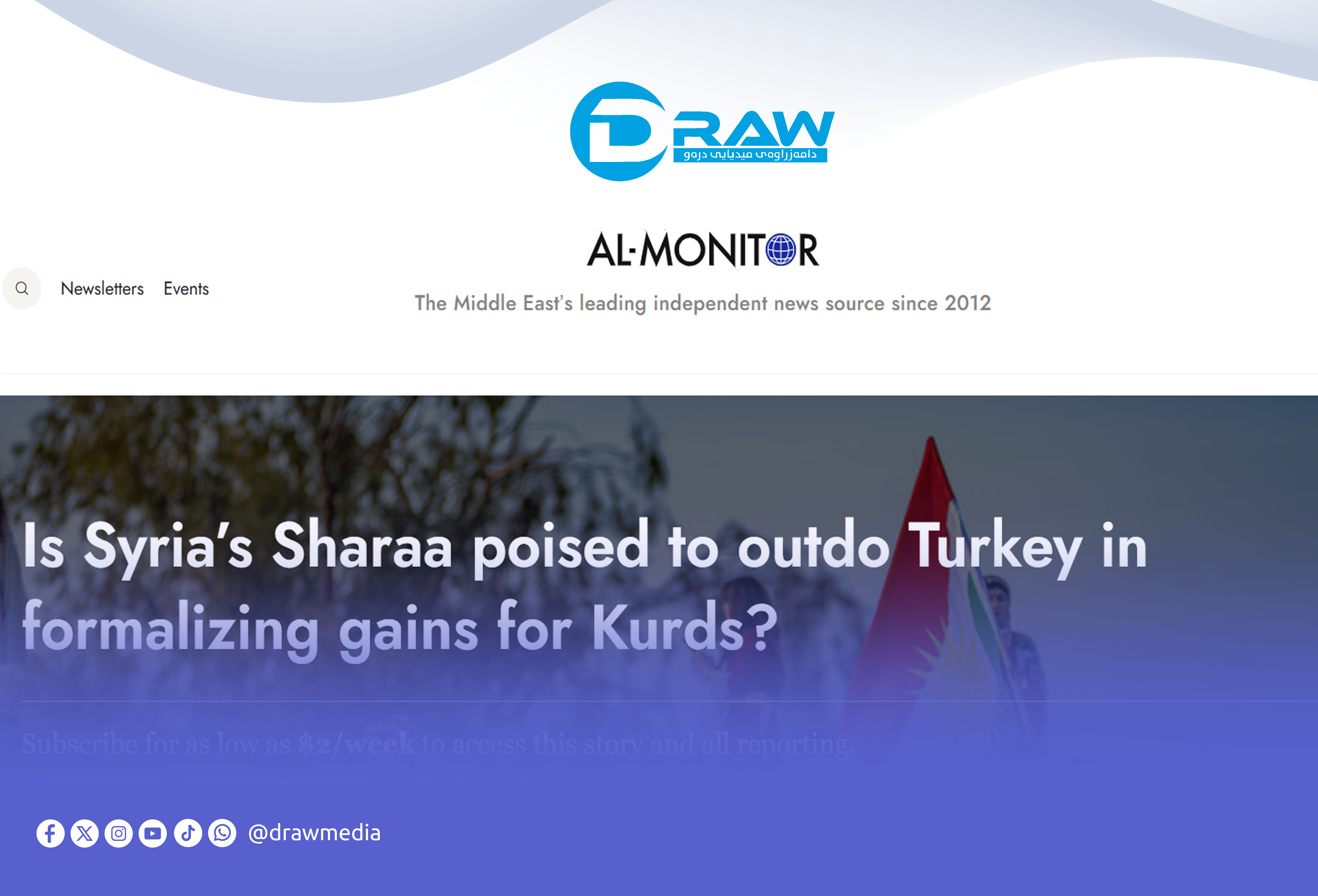
According to Al-Monitor, Damascus has made limited but notable progress in dialogue with Syria’s Kurds, despite Ankara’s attempts to shape any potential settlement.
Last Thursday, Ahmed al-Sharaa met in Damascus with a Kurdish delegation led by Mazloum Kobani, the commander-in-chief of the Syrian Democratic Forces (SDF), to assess efforts to integrate Kurdish civil and security institutions into the central government.
Sources familiar with the matter, speaking anonymously to Al-Monitor, described the talks as friendly.
Kobani’s visit began on Tuesday, coinciding with the withdrawal of U.S. forces from their last base in Qasrak in northeastern Syria.
Progress has been achieved in several areas since the U.S.-mediated agreement on January 29 came into effect, which ended prolonged clashes between the SDF and Damascus. Thousands of Kurds displaced after Turkey’s 2018 offensive in Afrin have continued returning, while many others displaced after the 2019 offensive are preparing to return.
However, major challenges remain. Kurds are seeking greater representation in government and calling for a new democratic constitution that guarantees the rights of women and minorities. The fate of thousands of female fighters who fought ISIS under the SDF remains unclear. The government insists that women’s units should be integrated into the police rather than the army—something opposed by the SDF and rejected by Sharaa’s jihadist allies.
Reports suggest that Sharaa recently renewed his offer for Kobani to become one of his deputies, but the SDF commander رفضed it. Ilham Ahmed also declined an advisory role.
Sources indicate both figures are hesitant to accept positions that would strengthen Sharaa’s image as a central leader without granting them real decision-making power.
Kobani is reportedly focusing on expanding his influence politically, not just militarily. Despite recent setbacks for the SDF, he remains one of the most influential and popular Kurdish leaders in Syria and is said to be considering forming a new political party.
Ilham Ahmed may still consider the position of Deputy Foreign Minister, but Turkey opposes her appointment. While Ankara has maintained direct contact with her for over a year on bilateral issues, it remains against giving her such a role.
The reasons behind Turkey’s opposition are unclear, but one likely factor is that Ankara does not want Syria to grant more recognition or status to its Kurds than Turkey grants to its own Kurdish population. This is particularly sensitive amid Turkey’s ongoing and complex negotiations with Abdullah Öcalan, the imprisoned leader of the Kurdistan Workers’ Party (PKK).
At the same time, controlling Damascus’s concessions to the Kurds allows Ankara to use this issue as leverage in further negotiations with Öcalan. However, this strategy carries complex and potentially conflicting consequences.
By closing the Nusaybin border crossing—which connects southeastern Turkey to northeastern Syria, an area under Kurdish control—Turkey enables its allied Sunni Arab militias to benefit from trade. This, in turn, pushes the Kurds to rely more on Damascus. The deeper the relationship between Damascus and the Kurds becomes, the less control Turkey may ultimately have.
Sharaa, an experienced strategist, understands that the Kurds can serve as a balancing force against his internal rivals. While he rejected Kurdish demands to remove the word “Arab” from Syria’s official name—keeping it as the Syrian Arab Republic—he has accepted other demands.
As a result, the Kurdish region in Syria (Rojava) continues to enjoy significant autonomy, alongside the symbolic presence of Syrian government officials in the area—for now.