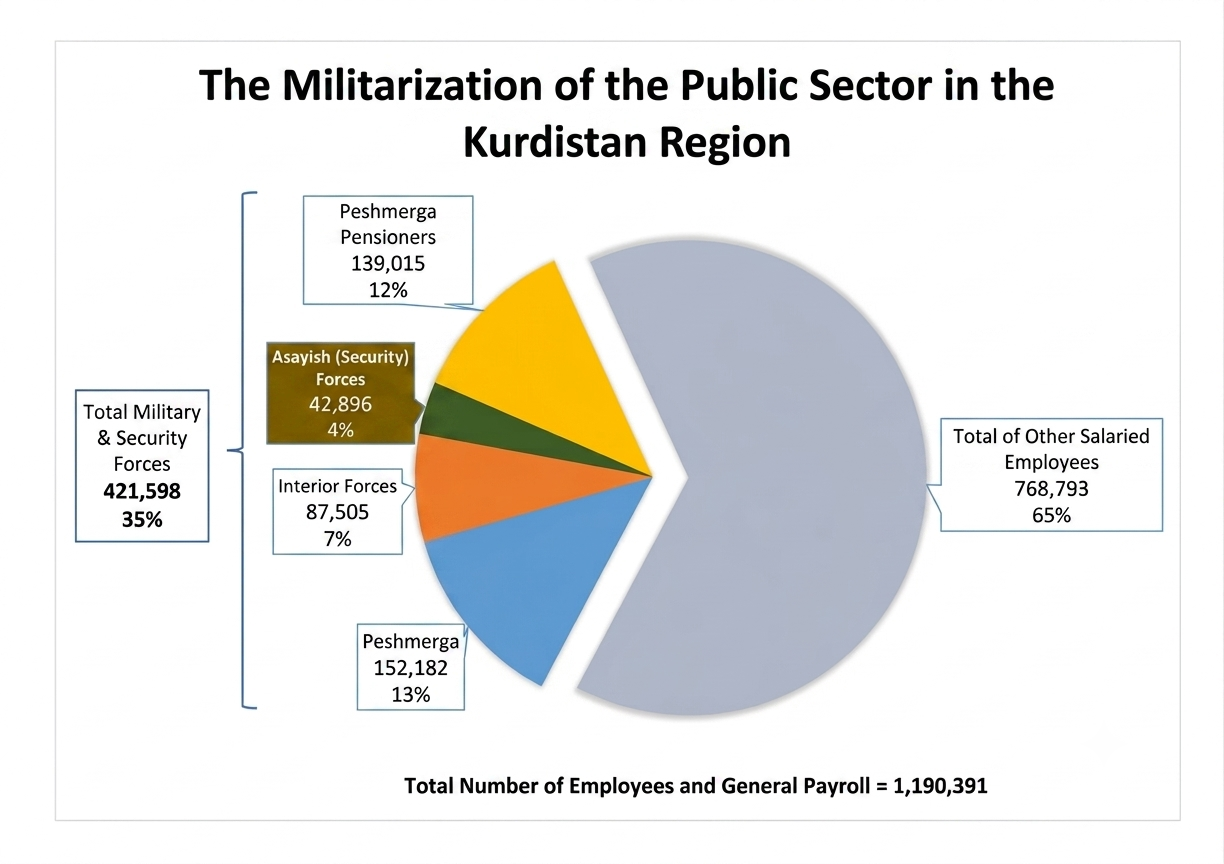
Alongside active personnel, the Region also supports 139,015 retired Peshmerga, a figure nearly equal to the number of active Peshmerga. From a public finance perspective, this creates a challenging pension structure. In most sustainable pension systems, three to four active employees are expected to support each retiree, whereas the current balance is much closer to one-to-one.
According to the Kurdistan Regional Government's Ministry of Finance, the Region has 1,190,391 public-sector employees and pension recipients, whose combined monthly payroll totals 945.817 billion Iraqi dinars. Military and security employees account for 35% of all public-sector salary recipients while receiving 41% of total salary expenditures, demonstrating the sector's significant share of government spending.
International Benchmarks for Military Size
There is no universally accepted military size suitable for every country. The appropriate number of armed forces depends on several considerations, including geopolitical conditions, perceived security threats, financial capacity, technological development, and defense strategy.
Nevertheless, defense studies commonly identify broad international benchmarks.
Peacetime
In stable conditions, governments generally seek to maintain security while limiting defense expenditures. Many military analysts suggest that a standing army should represent approximately 0.5% to 1% of the total population.
For example, a country with six million inhabitants would typically maintain between 30,000 and 60,000 active soldiers during peacetime.
Wartime or National Emergency
When countries confront armed conflict or serious external threats, they usually expand their armed forces through reserve mobilization or compulsory service. During these periods, military personnel may increase to 3%–5% of the population.
Historical experience also suggests that maintaining more than 10% of a country's population under arms for an extended period is economically unsustainable, as it significantly reduces the workforce available for agriculture, manufacturing, healthcare, and other essential sectors.
The Three-to-One Principle
Military doctrine commonly states that an attacking force generally requires a numerical advantage of roughly three to one against a well-prepared defender. Consequently, countries that adopt primarily defensive military strategies often require fewer active troops than those maintaining offensive capabilities.
International Standards for Police and Internal Security
Military forces are evaluated differently from domestic security services such as police and intelligence agencies.
Police-to-Population Ratios
International organizations, including the United Nations, commonly use the police-to-population ratio to assess policing levels.
Under normal circumstances, the widely accepted benchmark is approximately:
One police officer for every 400 to 450 residents, or roughly 0.22%–0.25% of the population.
In densely populated urban areas, this may increase to:
One police officer for every 250 to 300 residents, equivalent to approximately 0.33%–0.40% of the population.
During Internal Crises
Periods of political instability, domestic unrest, or counterterrorism operations often require larger internal security forces. In such situations, security personnel may account for 0.5%–1.5% of the population, or approximately one security officer for every 70 to 100 citizens, reflecting increased requirements for checkpoints, public order, and the protection of government facilities.
Military and Security Personnel in the Kurdistan Region
According to Iraq's 2024 national census, the Kurdistan Region has a population of 6,370,668.
The latest figures from the Kurdistan Regional Government Ministry of Finance indicate that there are 1,190,391 public-sector salary recipients, with a total monthly payroll of IQD 945.817 billion. Within this workforce, the military and security sector is composed of:
Peshmerga: 152,182 personnel
Police (Ministry of Interior): 87,505 personnel
Asayish (Security Service): 42,896 personnel
Retired Peshmerga: 139,015 beneficiaries
The following analysis examines each component of the security sector.
1. Peshmerga Forces
The 152,182 active Peshmerga account for approximately 2.38% of the Kurdistan Region's population. This proportion is considerably higher than the commonly cited international peacetime benchmark of 0.5–1% of the population for standing armed forces.
2. Police Forces
The 87,505 police personnel represent approximately 1.37% of the population, equivalent to roughly one police officer for every 73 residents.
By comparison, the widely accepted international benchmark is approximately one police officer per 400 people (0.25%). This suggests that the Kurdistan Region's police density is about five times higher than the standard typically observed in stable civilian settings, reflecting an extensive internal security presence.
3. Asayish (Internal Security)
The 42,896 Asayish personnel constitute approximately 0.67% of the population, or roughly one officer for every 148 residents.
Combined with the police force, this relatively large internal security apparatus indicates that maintaining domestic security and responding to internal threats remain significant government priorities.
4. Retired Peshmerga
In addition to active personnel, the Kurdistan Region supports 139,015 retired Peshmerga, a number that is nearly equal to the active Peshmerga force.
From a public finance perspective, such a ratio places considerable pressure on pension sustainability. International pension models generally recommend at least three to four active contributors for every retiree to maintain a financially balanced retirement system.
Key Findings and Strategic Implications
Overall, 4.43% of the Kurdistan Region's population is employed in the military and security sectors. Put differently, approximately one out of every 22–23 residents, including children and older adults in the total population count, is either a member of the armed forces or employed by a security institution.
When combined with the 139,015 retired Peshmerga, these figures have several important implications.
Economic burden: Allocating more than 4.4% of the population to military and security employment places a substantial financial burden on the public budget, particularly through salaries and operating costs. As a result, fewer public resources remain available for investment in infrastructure, economic diversification, and development sectors.
Security-oriented governance: The high ratio of one security-sector employee for every 23 residents suggests that the Kurdistan Region continues to operate in an environment requiring a strong security presence, rather than one characterized by fully normalized civilian conditions.
Labour-intensive security model: The large size of the security workforce indicates that the Region continues to rely primarily on a personnel-intensive security model. This contrasts with more technologically advanced security systems, where greater investment in surveillance technologies, intelligence capabilities, and modern equipment allows governments to maintain security with fewer personnel.