The Kurdistan Region is home to a rich mosaic of ethnic and religious communities. According to the Kurdistan Regional Government (KRG), eight officially recognized religions and faiths coexist alongside ethnic groups including Turkmens, Chaldean Syriac Assyrians, and Armenians.
Representation and Governance
Minority communities have played an active role in the Kurdistan Region’s political institutions since the establishment of the KRG. Their participation has continued across successive administrations, and in the ninth cabinet they hold two ministerial portfolios.
Minority representation has been guaranteed through quota seats and other political mechanisms since the first parliamentary elections in 1992. Currently, the Ministry of Transport and Communications is held by a representative of the Christian community, while the Ministry for Regional Affairs and Components is led by a representative of the Turkmen community.
The ninth cabinet's governing program emphasizes peaceful coexistence among all ethnic and religious groups, including Kurds, Turkmens, Chaldeans, Assyrians, Syriacs, Armenians, Arabs, Muslims, Christians, Yazidis, Kakais, Mandaeans, and Zoroastrians.
Education and Cultural Preservation
The KRG supports the preservation of minority languages, cultures, and traditions through dedicated educational and cultural institutions.
There are 19 Turkmen-language schools serving 1,995 students and staffed by 285 teachers and employees. Syriac-language education is provided through 50 schools attended by 6,690 students and supported by 634 teachers and staff members. In addition, 24,369 students are enrolled in the Yazidi Kurdish curriculum.
The Ministry of Culture and Youth promotes minority heritage through specialized directorates for Turkmen and Syriac culture and arts, while the Ministry of Education maintains dedicated departments overseeing instruction in these languages.
Religious Sites and Communities
Islam remains the majority religion in the Kurdistan Region. The region is home to 6,224 mosques, including 454 built during the ninth cabinet's tenure. Nearly 250 mosques and Islamic religious sites have also undergone renovation.
Christianity is the second-largest faith community. The region contains 273 churches, monasteries, and Christian shrines representing 14 officially recognized Christian denominations. Since 2005, nearly 20 new churches have been built, while approximately 70 percent of Christian religious sites have been restored.
The Kurdistan Region became a refuge for Christians fleeing violence elsewhere in Iraq, particularly following sectarian conflict after 2006 and the rise of ISIS in 2014. Around 138,000 Christians from the Nineveh Plain sought safety in the region in 2014. Today, an estimated 350,000 Christians live across the Kurdistan Region, Kirkuk, and Mosul.
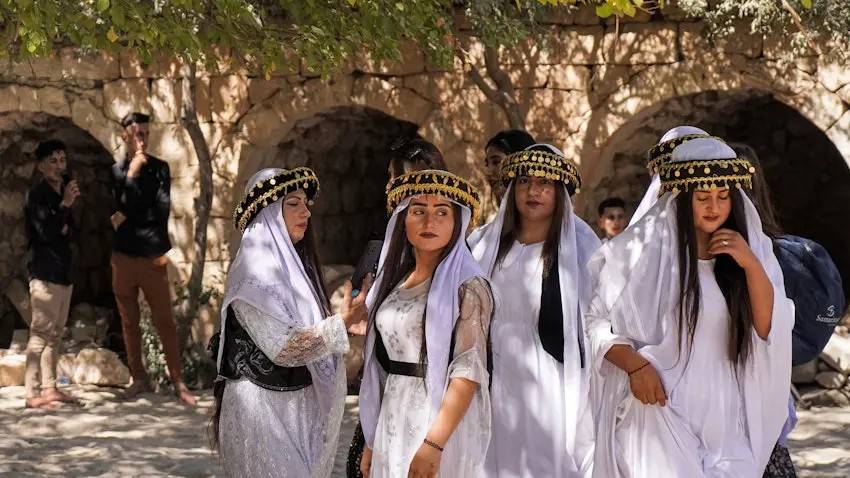
Yazidism, one of Kurdistan's oldest religions, has an estimated population of between 500,000 and 700,000 adherents. Hundreds of Yazidi religious sites are located throughout the region and nearby Kurdish areas. The sacred temple of Lalish attracts approximately 200,000 visitors each year, particularly during the annual Jamayi festival.
Other recognized religious communities include Mandaeans, Kakais, Shabaks, Feylis, Zoroastrians, and several smaller groups, whose combined population is estimated at around 100,000 people.
In total, the Kurdistan Region contains 325 religious sites dedicated to Yazidis and other minority communities.
Religious Freedom and Civil Society
Religious freedom and minority rights are protected by Law No. 5 of 2015, enacted by the Kurdistan Parliament. The legislation safeguards the rights and identities of ethnic and religious communities and was approved unanimously.
The KRG also supports civil society initiatives promoting coexistence and cultural diversity. Currently, 36 licensed organizations operate in these fields, including 32 local organizations and four international groups.
Interfaith Relations and International Recognition
The Kurdistan Region officially recognizes numerous religious and cultural celebrations, with several designated as public holidays.
A milestone in interfaith relations was the visit of Pope Francis in March 2021. During his historic trip, he was welcomed in Erbil by Kurdish leaders and met separately with Masoud Barzani. The visit highlighted the Kurdistan Region’s reputation for religious tolerance and peaceful coexistence.
Another notable event took place on 23 April 2025, when religious and political leaders gathered in Erbil for a National Day of Prayer under the theme “Towards Unity in Faith.”
Relations with the Vatican
Over the past two decades, the Kurdistan Region has maintained strong ties with the Holy See. As instability affected other parts of Iraq, the region became a safe haven for Christians and other vulnerable communities.
Relations between the KRG and the Vatican have been strengthened through frequent official visits, culminating in Pope Francis’s landmark visit and several subsequent visits by Kurdish officials to the Vatican.
The Peshmerga and the Protection of Minorities
During the war against ISIS, the Kurdistan Region hosted nearly two million displaced people and refugees. The Peshmerga played a critical role in defending minority communities, protecting civilians, and helping liberate territories occupied by ISIS.
Religious leaders and international officials have repeatedly praised the Peshmerga for safeguarding vulnerable populations and preserving the region’s religious and ethnic diversity. Vatican representatives, in meetings with Kurdish leaders in 2016 and 2019, commended the Peshmerga's efforts in defending humanity against ISIS and protecting displaced communities during some of Iraq’s most difficult years.